




Climate Finance and the Global South
Analysis of climate finance challenges in emerging economies, based on 'Western Climate Finance is Failing the Global South' | Observer Research Foundation.
OPEN SOURCEThe global climate finance architecture is failing to meet the needs of emerging economies, resulting in high costs of capital that hinder the green transition. BRICS countries face unique challenges in financing their transitions, necessitating the development of more accessible financial instruments and mechanisms.
High capital costs in emerging economies stem from macroeconomic risks, currency fluctuations, and geopolitical uncertainties, complicating their investment attraction efforts. The panel discusses the fairness of global climate finance, questioning the reliance of BRICS nations on external financial institutions and whether the core issue lies in capital availability or the adequacy of financial instruments.
Emerging economies are challenged to finance both adaptation and mitigation efforts while also addressing industrialization and food security amidst constrained global financial conditions. The UNEP adaptation gap report estimates that developing countries will require about $365 billion annually for adaptation by 2035, yet current international public adaptation finance stands at only $26 billion, indicating a substantial funding gap.
Adaptation projects in developing countries struggle to attract private finance due to their long-term, indirect returns, highlighting the need for robust public finance support. Blended finance mechanisms can help mitigate early-stage risks and draw in private capital, while first-loss capital structures can encourage institutional investors to commit to long-term projects.
The New Development Bank aims to enhance climate finance in BRICS countries by improving access to green and sustainability-linked bonds, while also focusing on project preparation and capacity building. There is a strong call for at least 50% of climate funding to be allocated to women, emphasizing the critical role of gender equity in climate finance.
The discussion pointed to the need for a reimagined approach to development banks, advocating for solutions that yield multiple benefits for communities and align with sustainable development goals.
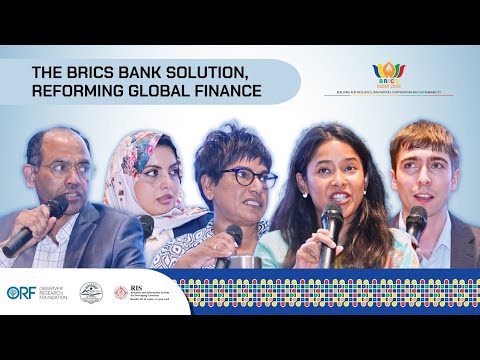
- The urgency of the green transition underscores the need for accessible, affordable, and scalable climate finance in emerging economies
- BRICS countries, as significant energy consumers with robust industrial sectors, encounter distinct challenges in financing their green transitions, which must prioritize growth and job creation over luxury initiatives
- High capital costs in emerging economies stem from macroeconomic risks, currency fluctuations, and geopolitical uncertainties, complicating their investment attraction efforts
- The panel discusses the fairness of global climate finance, questioning the reliance of BRICS nations on external financial institutions and whether the core issue lies in capital availability or the adequacy of financial instruments
- While high capital costs yield higher returns for creditors, they obstruct essential investment flows to emerging markets, reinforcing financial inequality
details
Read full analysis
- Highlight the urgent need for accessible and affordable climate finance
- Argue that high capital costs hinder the green transition and exacerbate inequalities
- Claim that existing financial institutions are sufficient for addressing climate finance needs
- Suggest that emerging economies must adapt to global financial rules and structures
- Acknowledge the role of institutions like the New Development Bank in facilitating climate finance
- Recognize the importance of blended finance mechanisms in attracting private investment
- Macroeconomic risks, currency volatility, and geopolitical uncertainties significantly drive up the cost of capital in emerging economies, hindering access to climate finance
- High capital costs create a paradox where they benefit creditors through higher returns while simultaneously obstructing essential investment flows to emerging markets
- A major challenge in climate finance is the scarcity of bankable projects, especially in adaptation, due to underdeveloped infrastructure that limits investment opportunities
- Institutions like the New Development Bank are vital for lowering capital costs and enhancing infrastructure to attract private investment in climate initiatives
- Collaboration on standards and screening criteria among BRICS countries is crucial to improve financial flows and tackle the challenges of climate adaptation and resilience
details
details
details
- Emerging economies are challenged to finance both adaptation and mitigation efforts while also addressing industrialization and food security amidst constrained global financial conditions
- The UNEP adaptation gap report estimates that developing countries will require about $365 billion annually for adaptation by 2035, yet current international public adaptation finance stands at only $26 billion, indicating a substantial funding gap
- Climate-related financing costs in developing economies can be up to 12 times higher than in advanced economies, driven by factors such as currency volatility and risk perceptions
- Egypts multi-dimensional climate finance strategy includes a National Climate Change Strategy and blended finance initiatives, but stresses that national reforms need to align with changes in global financial conditions for effectiveness
- Equitable access to capital is crucial for countries with significant developmental needs, presenting an opportunity for BRICS nations to play a pivotal role in addressing climate finance challenges
details
details
details
- Current climate finance flows are inadequate for emerging economies, which require substantial funding for adaptation, mitigation, and resilience projects
- India advocates for reforms in international climate finance to ensure fair access to capital for developing nations facing significant funding gaps
- Public funding constitutes about 70% of climate finance, while private investment remains largely untapped despite the need for innovative financing solutions
- The OECD highlights a commitment from developed nations to achieve a $100 billion climate finance goal by 2025, yet this falls short of the estimated $1.3 trillion needed annually by developing countries by 2035
- Emerging economies are investigating blended finance and market-based instruments to attract private investment, though reliance on debt instruments raises sustainability concerns
details
- Emerging economies struggle with high capital costs and limited access to climate finance, which hampers their ability to effectively implement green projects
- Sovereign credit ratings in developing regions, especially in Africa, adversely affect their creditworthiness, complicating the funding of climate initiatives
- The OECDs assertion of achieving the $100 billion climate finance target is under scrutiny due to unclear definitions of what qualifies as legitimate climate finance
- Multilateral climate funds, including the Global Environment Facility and the Global Climate Fund, are vital for supporting developing nations, but their complex accreditation processes increase financing costs
- There is an urgent need for innovative financial instruments and frameworks to broaden funding sources and encourage participation from both retail and institutional investors in climate-related financial products
details
- The green transition offers opportunities but risks exacerbating inequalities if not pursued with a focus on justice and social resilience
- BRICS countries are urged to view climate finance as a tool for promoting justice, dignity, and inclusive development rather than just an economic mechanism
- A human-centric approach to climate finance is crucial, prioritizing the rights and dignity of vulnerable groups, particularly women and children, who are most affected by climate change
- Implementation of climate finance varies widely among BRICS nations due to structural and systemic differences, necessitating customized strategies
- It is essential to evaluate the impact of climate financing on marginalized communities to ensure their needs and rights are central to the green transition
- Inequities in climate finance significantly affect women, children, and marginalized groups, highlighting the need for their inclusion in energy transition strategies
- International agreements stress the importance of prioritizing vulnerable populations in just energy transitions
- In South Africa, the government is working to ensure that vulnerable communities access climate finance, although progress is slower than expected
- A risk-sharing framework is vital for BRICS nations to attract climate finance, as existing structural risks and lengthy project timelines deter investment
- Strong government commitment to climate goals, as outlined in national contributions to international agreements, is essential for maintaining stable private capital flows amid political changes
- Adaptation projects in developing countries struggle to attract private finance due to their long-term, indirect returns, highlighting the need for robust public finance support
- Blended finance mechanisms can help mitigate early-stage risks and draw in private capital, while first-loss capital structures can encourage institutional investors to commit to long-term projects
- Political risk insurance and foreign exchange facilities are essential for alleviating investor uncertainties, complemented by parametric insurance mechanisms that offer rapid financial assistance following climate-related events
- The proposed PREX adaptation finance platform aims to standardize risk assessments and facilitate project preparation, thereby making it easier to engage institutional investors for smaller projects
- The New Development Bank has the potential to improve the appeal of green and sustainability-linked bonds and support capacity building for climate project development in emerging economies
- The New Development Bank aims to enhance climate finance in BRICS countries by improving access to green and sustainability-linked bonds, while also focusing on project preparation and capacity building
- Indias Mission Life initiative highlights the necessity of community engagement in climate action, emphasizing that effective climate strategies require public participation beyond financial investment
- Challenges in adaptation finance stem from the long-term and indirect nature of returns, necessitating public finance mechanisms such as blended finance and political risk insurance to attract private investment
- BRICS climate finance strategies should prioritize community-level resilience, borrowing best practices and creating tailored financial instruments to address local needs and ensure inclusivity
- The discussion emphasizes the need for a balance between public sector-led financing and market-based instruments to effectively tackle climate injustice, particularly for vulnerable populations affected by climate change
- Between 22% and 27% of global climate finance is funneled through Multilateral Development Banks, with South-South financial flows estimated at USD 13.3 to 19.8 billion
- Panelists highlighted the importance for BRICS nations to focus on reducing technology costs and creating innovative financial instruments to improve access to climate finance
- The New Development Bank aims to allocate around 40% of its portfolio to climate initiatives, promoting the use of local currency-denominated green bonds
- There is a strong call for at least 50% of climate funding to be allocated to women, emphasizing the critical role of gender equity in climate finance
- The discussion pointed to the need for a reimagined approach to development banks, advocating for solutions that yield multiple benefits for communities and align with sustainable development goals
details
details
details
The high cost of capital in emerging economies is influenced by macroeconomic risks and geopolitical uncertainties, yet the reliance on external financial institutions raises questions about the adequacy of available instruments. Inference: If BRICS nations continue to depend on these institutions, they may struggle to achieve the necessary scale and affordability for their green transitions, potentially perpetuating financial inequality.
This analysis is an original interpretation prepared by Art Argentum based on the transcript of the source video. The original video content remains the property of the respective YouTube channel. Art Argentum is not responsible for the accuracy or intent of the original material.