




Greece's Fuel Price Reduction Analysis
Analysis of fuel price reduction in Greece, based on "Agreement for a temporary reduction of 10 cents in gasoline and 5 cents in Diesel" | NaftemporikiGR.
OPEN SOURCEThe Greek government is implementing a temporary reduction in fuel prices, decreasing gasoline by 10 cents and diesel by 5 cents per liter. This measure aims to provide immediate relief to consumers amidst rising fuel costs.
Ongoing discussions highlight the impact of international developments and government tax policies on fuel pricing. The current price of unleaded gasoline is approximately 1.88 euros per liter, while diesel is around 1.84 euros.
Despite the temporary price cuts, taxes significantly contribute to fuel prices in Greece, with consumers facing about 95% of the price due to taxation. This positions Greece among the highest in the EU for fuel taxes.
Criticism arises regarding the government's reluctance to further reduce taxes, as maintaining fiscal stability is prioritized. This raises concerns about long-term fuel affordability for consumers.
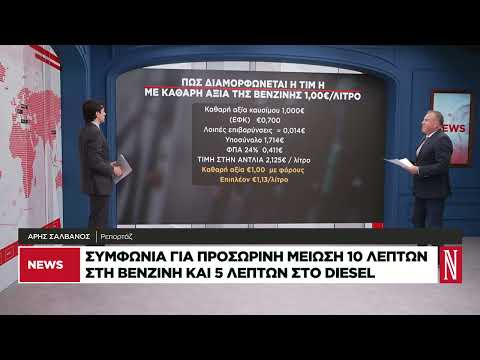
- The Greek government is temporarily reducing fuel prices, cutting gasoline by 10 cents and diesel by 5 cents per liter
- There is ongoing debate about the influence of international developments and government tax policies on fuel pricing
- Currently, unleaded gasoline costs approximately 1.88 euros per liter, while diesel is around 1.84 euros, with the new measures expected to provide slight reductions
- Taxes significantly contribute to fuel prices in Greece, with consumers facing about 95% of the price due to taxation, positioning Greece among the highest in the EU for fuel taxes
- The government is criticized for not further reducing taxes, citing the need to maintain fiscal stability, which raises concerns about fuel affordability for consumers
Read full analysis
- Advocate for temporary price reductions to alleviate consumer burden
- Highlight the need for fiscal stability despite high taxation
- Argue that the temporary cuts do not address the underlying tax issues
- Call for more substantial tax reductions to improve fuel affordability
- Acknowledge the significant role of taxation in fuel pricing
- Recognize the current fuel prices in Greece as among the highest in the EU
The reduction in fuel prices assumes that consumers will benefit directly, yet it overlooks the significant role of taxation, which constitutes about 95% of fuel costs. Inference: This suggests that without addressing the underlying tax structure, the temporary price cut may not substantially alleviate consumer burden, raising questions about the government's commitment to long-term affordability.
This analysis is an original interpretation prepared by Art Argentum based on the transcript of the source video. The original video content remains the property of the respective YouTube channel. Art Argentum is not responsible for the accuracy or intent of the original material.