



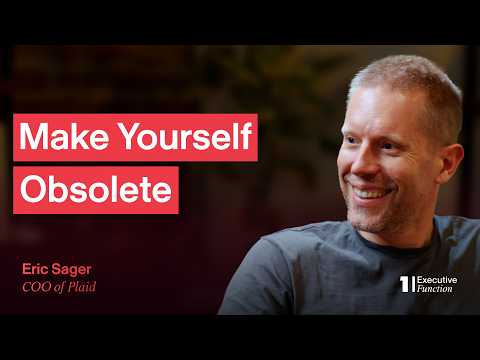
Why great leaders make themselves obsolete | Eric Sager (COO, Plaid)
Analysis of why great leaders make themselves obsolete | eric sager (coo, plaid), based on "Why great leaders make themselves obsolete | Eric Sager (COO, Plaid)" | First Round Capital.
OPEN SOURCEEric Sager discusses the importance of maintaining focus on business growth and customer service during turbulent times. He emphasizes that a resilient company culture is built on customer-centric values rather than specific milestones. Eric Sager emphasizes the necessity for founders to intentionally shape their company culture, which significantly influences organizational identity. He discusses the challenges leaders face in maintaining cultural integrity when short-term goals conflict with long-term values.
Eric Sager discusses the importance of a flat organizational structure and the balance between speed, risk, and cost in decision-making. He emphasizes that accuracy is crucial for maintaining customer trust, especially in high-stakes scenarios. Eric Sager discusses the evolution of Plaid's organizational structure as it transitioned from a startup to a multi-product company, emphasizing the need for specialization to meet diverse customer needs. He highlights the importance of balancing speed with accuracy to enhance customer experience and minimize repetitive interactions.
- Navigating dynamic changes, such as the pandemic and market fluctuations, requires leaders to maintain a focus on advancing the business and serving customers, rather than getting sidetracked by external events
- Effective communication is essential for leaders to frame significant events as milestones in a broader journey, which helps sustain team focus and morale
- A resilient company culture prioritizes customer service and ecosystem development over specific milestones like acquisitions or IPOs, fostering a stable long-term vision
- A small, dedicated team can handle major transactions while the larger organization concentrates on core operations, ensuring growth despite external challenges
- Intentional efforts to formalize a strong foundational culture are necessary, emphasizing customer-centric values that guide the organization through various challenges
Read full analysis
- Founders should actively shape their desired company culture, as this intentionality influences the organizations identity
- Hiring practices must reflect the intended culture, necessitating careful selection of candidates who will enhance that environment, particularly in leadership roles
- Leaders face challenges in maintaining cultural integrity when short-term objectives clash with long-term values, requiring them to uphold cultural principles despite immediate pressures
- Open communication is essential for addressing cultural violations by high-performing employees, enabling constructive feedback that can foster positive behavioral changes
- As organizations expand, establishing clear decision-making processes becomes vital; appointing a single decision-maker can mitigate confusion and bureaucratic delays
- Plaid fosters a flat organizational structure by minimizing unnecessary layers and hiring frontline employees who can also take on individual contributor roles, promoting accountability and expertise
- Eric Sager highlights the need to balance speed, risk, and cost in decision-making, asserting that faster isnt always better, particularly in a business where accuracy is crucial for maintaining customer trust
- He stresses the importance of clear communication regarding trade-offs in project execution, guiding teams on when to prioritize thoroughness over speed in high-stakes scenarios
- Sagers collaboration with Plaids founder, Zach, creates a productive tension that balances the urgency of speed with a methodical approach, contributing to the companys sustainable success
- Eric Sager emphasizes the need to balance speed with the diverse needs of customer segments as Plaid transitioned from a startup to a multi-product company
- He advocates for avoiding unnecessary complexity in the early stages, focusing on achieving the right product-market fit before moving towards specialization
- As Plaid expanded, the emergence of distinct customer needs led to a shift from a generalist approach to a more specialized structure to effectively serve startups, mid-market, and enterprise clients
- Sager highlights the challenges associated with handoffs between sales and account management, promoting a more integrated approach to enhance customer experience and minimize repetitive interactions
- The evolution of Plaids product offerings and customer interactions underscores the importance of adaptability in organizational design to meet varying expectations across different market segments
- Plaid transitioned from a generalist approach to a specialized organizational structure, aligning teams by customer segments and verticals to enhance customer satisfaction
- Integrating functions within each segment improved the end-to-end customer relationship, facilitating smoother transitions between sales, account management, and support, which led to better implementation and upselling opportunities
- While specialization has benefits, it also introduces challenges such as reduced flexibility and potential mismatches between team capabilities and customer needs, highlighting the importance of understanding business evolution
- Plaid has refined its strategy by incorporating verticals within enterprise segments, allowing for tailored expertise in specific industries like healthcare and automotive, enhancing customer engagement
- The establishment of horizontal teams to support vertical teams ensures that segment leaders can manage overall customer relationships while still having access to specialized knowledge in areas such as fraud and payments
- Eric Sager advocates for maintaining spare capacity within organizations, arguing that operating below full capacity enhances flexibility and responsiveness in the rapidly changing fintech environment
- Plaid has shifted from a generalist model to a specialized structure, creating dedicated segments for various customer types and verticals, which has led to improved customer satisfaction and operational efficiency
- Sager emphasizes the importance of aligning product development with customer needs across segments, ensuring tailored solutions that contribute to the overall growth of the network
- The integration of product areas focused on payments, fraud, and credit streamlines the approach to customer demands, with product managers prioritizing features that enhance network value
- Sager reflects on past organizational decisions, highlighting the need to balance specialization with flexibility to adapt to evolving market conditions and customer expectations
details
- Plaid aims to develop high-quality products that enable large customers to implement and scale independently, minimizing the need for direct company interaction
- The company takes a proactive stance on customer engagement, monitoring integration health and reaching out to assist customers to ensure optimal results
- Customer awareness of Plaids diverse product offerings is essential for expansion, as satisfied clients are more inclined to explore additional services once they recognize their value
- While striving for minimal human intervention in customer interactions, Plaid acknowledges the critical role of account managers in providing a seamless experience across multiple products
- Eric Sager emphasizes the importance of investing in customer support to enhance satisfaction and foster long-term relationships, even if it results in short-term losses
- Eric Sager underscores the importance of delivering value to all consumers, including those who do not directly pay for Plaids services, as a fundamental aspect of the companys mission
- He argues that improving consumer outcomes enhances decision-making and reduces costs, benefiting the broader ecosystem
- Sager evaluates success not just by revenue but by the overall value generated for consumers and the effectiveness of Plaids financial solutions
- He emphasizes the need for a resilient team and infrastructure that can function independently of his direct involvement, ensuring the companys stability
- Sager considers the ability to make oneself obsolete a hallmark of effective leadership, indicating that a well-organized company can succeed without reliance on any single leader
- Eric Sager advocates for leaders to evolve in their roles, suggesting that staying too long in the same tasks reflects an inability to build a sustainable team
- He dedicates 20% of his time to enjoyable tasks like selling to key customers, while focusing 80% on strategic contributions that drive company growth
- Sager values personal connections with team members and customers, often reaching out to new employees to foster respect and boost team morale
- He emphasizes the importance of understanding the organizational structure and available talent, promoting delegation for significant decisions when capable individuals are present
- His decision-making approach considers the long-term impact and the talent pool, allowing him to stay engaged without resorting to micromanagement
details
- Eric Sager stresses the need for organizations to maintain spare capacity, enabling flexibility and rapid responses to unexpected challenges
- He believes that operating at full capacity can impede a companys ability to adapt and correct mistakes, likening it to athletes needing energy reserves for critical moments
- Sager underscores the importance of direct engagement with team members and customers to enhance decision-making and gain a deeper understanding of the business
- He points out that genuine passion for the companys mission is essential for motivating employees, contrasting it with executives who may lack personal investment
- Eric Sager advocates for maintaining daily interactions with customers and team members to better understand their evolving needs
- He believes that smaller, consistent interactions are more beneficial for skill development than infrequent, intensive sessions
- Sager divides his weekly focus into 25% on ecosystem health, 50% on business health, and 25% on team development, emphasizing the need for balance in leadership
- He prioritizes hiring individuals who are genuinely passionate about the companys mission, as this leads to improved performance and engagement
- Sagers leadership meetings begin with sharing customer insights, promoting a culture of learning and collaboration within his team
details
details
- Eric Sager stresses the significance of hiring individuals who are truly passionate about the companys mission, as a lack of alignment can lead to poor performance and cultural misfit
- He points out the difficulty in evaluating candidates genuine commitment during interviews, noting that diverse job interests may signal a lack of true affinity for the role
- Sager warns that while expertise is important, an over-reliance on it can result in neglecting essential cultural fit, which is vital for long-term success in a fast-changing environment
- He compares founders to executives, highlighting that founders have an intrinsic love and commitment to their company that is hard for others to replicate, influencing their risk tolerance and decision-making
- Sager cautions that the perceived benefits of hiring experienced individuals may fade if they do not share the necessary cultural alignment and passion for the companys mission
- Founders exhibit a unique resilience and commitment to their companies, often facing challenges that hired executives may not endure due to their personal investment in the businesss success
- Successful founders are marked by their determination and ability to navigate difficult times, earning deep respect from their teams and stakeholders
- Eric Sager reflects on his growth over seven years at Plaid, emphasizing a continuous drive for improvement that goes beyond mere achievements
- Sager acknowledges the challenge of balancing success with an ongoing pursuit of betterment, a common struggle for many high achievers
- Eric Sager prioritizes team development and success over tactical job functions, fostering a supportive environment that encourages growth
- His investment in team members has resulted in a high rate of internal promotions, reflecting his commitment to their confidence and success
- Sager compares leadership to sports, emphasizing the importance of trust and support in helping individuals thrive, while noting the negative impact of a lack of these elements
- He is driven by a strong sense of purpose, aiming to enhance consumer lives through Plaids products, even if consumers are unaware of his contributions
- Sager aspires for his colleagues to achieve their full potential during their time with him, focusing on creating meaningful impacts rather than just job satisfaction
details
- Eric Sager highlights the significance of investing in team members, drawing from his own experiences with supportive mentors to help them realize their full potential
- He believes that fostering a supportive environment encourages employees to take risks, which has led to many team members at Plaid advancing to key roles
- Sager acknowledges that leadership can be challenging, but the overall positive impact on team members growth and success is what truly matters
- He aspires for his legacy to reflect a positive contribution to consumers lives and to empower his team to achieve their best, emphasizing the lasting effects of their work at Plaid
The assumption that a strong foundational culture can withstand external challenges overlooks potential confounders such as market volatility and leadership changes. Inference: If the culture is not adaptable, it may falter under unforeseen pressures. The lack of a clear mechanism for measuring cultural resilience raises questions about its effectiveness in practice.
This analysis is an original interpretation prepared by Art Argentum based on the transcript of the source video. The original video content remains the property of the respective YouTube channel. Art Argentum is not responsible for the accuracy or intent of the original material.