




The Rise of AI Humanoid Robots
Analysis of AI humanoid robots, based on "Mitsubishi Reveals New AI Humanoid Robot 'N' Coming 2027" | AI News.
OPEN SOURCEJapan's robotics startup Highlanders has unveiled its new AI humanoid robot named 'N', powered by the Kepler V1.0 AI model. This model features a dual-brain architecture designed for real-time planning and reaction, addressing the challenges of Japan's shrinking workforce.
The Kepler model operates with a deliberative cerebrum for complex tasks and a reflexive cerebellum for quick responses. It is supported by a 10 billion parameter world model that predicts contact dynamics before motion occurs, enhancing the robot's operational efficiency.
Highlanders plans to manufacture 1,000 units of the N-robot monthly by 2027 through a partnership with Mitsubishi Motors, utilizing idle manufacturing capacity at Mitsubishi's Kyoto engine plant. This collaboration aims to meet the increasing demand for robotic solutions in various industries.
Boston Dynamics has showcased its Atlas robot, demonstrating advanced synchronized movements, while Tsubame Industries has introduced the Archax, a piloted mecha robot designed for hazardous environments. These developments highlight the competitive landscape in humanoid robotics.
Anthropic has enhanced its AI model Claude with a built-in sandbox browser, allowing for web interaction under strict safety protocols. Meanwhile, Meta has launched Muse Spark 1.1, a multimodal reasoning model with a public developer API, positioning itself competitively against OpenAI and Anthropic.
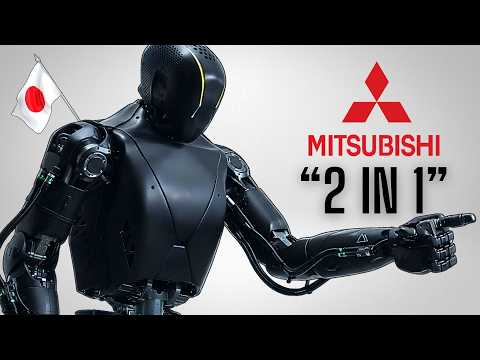
- Mitsubishis new humanoid robot N is powered by Highlanders Kepler v1.0 AI model, featuring a dual-brain architecture for simultaneous real-time planning and reaction
- The Kepler model includes a deliberative cerebrum for complex tasks and a reflexive cerebellum for quick responses, supported by a 10 billion parameter world model for predicting contact dynamics
- Highlanders plans to manufacture 1,000 units of the N-robot monthly by 2027, utilizing a partnership with Mitsubishi Motors to optimize idle manufacturing capacity
- Boston Dynamics Atlas robot has showcased advanced synchronized movements, highlighting competition in the humanoid robotics field, while Tsubame Industries has introduced the Archax, a piloted mecha robot for hazardous environments
- Anthropic has upgraded its AI, Claude, with a sandbox browser that enables web interaction while adhering to strict safety protocols, setting it apart from earlier versions
details
details
details
details
Read full analysis
- Propose a dual-brain architecture for real-time planning and reaction in humanoid robots
- Aim to produce 1,000 units of the N-robot monthly by 2027 to address labor shortages
- Highlight advancements in humanoid robotics by Boston Dynamics and Tsubame Industries
- Challenge Highlanders approach with alternative robotic solutions
- Anthropic and Meta are advancing AI tools for developers
- Metas Muse Spark 1.1 introduces a competitive public developer API
- Anthropic has launched a built-in sandbox browser for its AI model Claude, enabling web page interaction while adhering to strict safety protocols, which distinguishes it from earlier versions
- Metas Muse Spark 1.1 introduces a public developer API and is competitively priced against OpenAI and Anthropic, enhancing its appeal in the AI market
- The Muse Spark 1.1 upgrade supports multimodal reasoning and agentic tasks, allowing for advanced coding assistance and the direct conversion of visual mockups into code
- Metas shift to a self-serve API model represents a strategic change aimed at capturing a share of the paid API market, which is currently led by OpenAI and Anthropic
- Despite the advancements in Muse Spark 1.1, Meta has not released a detailed model card, leaving some technical specifications undocumented, contrasting with the transparency of its competitors
The reliance on Highlanders' dual-brain architecture assumes that real-time planning and reaction can be effectively decoupled, yet this may overlook the complexities of human-like adaptability in unpredictable environments. Inference: The success of this model hinges on the assumption that the 10 billion parameter world model can accurately predict dynamics, which remains untested in diverse real-world scenarios.
This analysis is an original interpretation prepared by Art Argentum based on the transcript of the source video. The original video content remains the property of the respective YouTube channel. Art Argentum is not responsible for the accuracy or intent of the original material.