




Iran's Strategic Calculations Post-War
Analysis of Iran's evolving strategies and public sentiment, based on 'What are Iran's next domestic, regional and international moves?' | Chatham House.
OPEN SOURCEIran's leadership is recalibrating its domestic and international strategies in response to ongoing conflict and sanctions. The shift towards a more aggressive military posture reflects a focus on regime resilience amid significant challenges.
The ongoing war has prompted Iran to shift its military strategy from defense to a more aggressive stance, employing missiles and drones against regional adversaries, including Israel and US interests. Despite facing challenges such as the loss of key leaders, Iran's focus on regime resilience has enabled it to sustain operations amid intense bombardment.
Diplomatic uncertainties, particularly regarding negotiations with the US, continue to shape Iran's strategic decisions, as reflected in ongoing military confrontations and rising tensions in the region, including incidents in Lebanon. The political landscape is marked by fluidity and uncertainty, with power dynamics becoming more decentralized.
Public sentiment in Iran has shifted towards national unity in response to external threats, despite ongoing economic challenges. The war has prompted a potential redefinition of Iran's political landscape and altered traditional political alliances.
The Iranian leadership is increasingly distrustful of US intentions, leading to more stringent demands in negotiations, including asset freezes and a ceasefire in Lebanon. The political environment has become more militarized, with heightened repression making it challenging for protest movements to emerge after the war.
The outlook for the Iranian populace is bleak, with expectations of tighter government controls and escalating conflict potentially worsening the situation. The evolving roles of Iran's military create a significant dynamic that could impact domestic stability and the push for change.
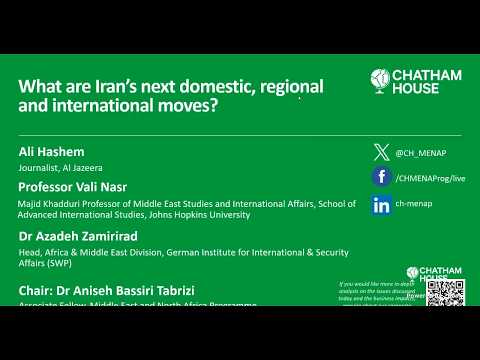
- Irans leadership is adjusting its domestic and international strategies in light of a prolonged conflict characterized by a fragile ceasefire and significant sanctions
- The ongoing war has prompted Iran to shift its military strategy from defense to a more aggressive stance, employing missiles and drones against regional adversaries, including Israel and US interests
- Despite facing challenges such as the loss of key leaders, Irans focus on regime resilience has enabled it to sustain operations amid intense bombardment
- Diplomatic uncertainties, particularly regarding negotiations with the US, continue to shape Irans strategic decisions, as reflected in ongoing military confrontations and rising tensions in the region, including incidents in Lebanon
Read full analysis
- Recalibrates military strategy to a more aggressive posture
- Focuses on regime resilience amid external pressures
- Maintain pressure through sanctions and military presence
- Distrustful of Irans intentions and military capabilities
- Public sentiment is divided, with some supporting the regime for stability
- Economic conditions are worsening, complicating governance
- Irans military strategy has shifted to a more aggressive stance, leveraging its own capabilities, including missiles and drones, to deter adversaries and project power
- The ongoing conflict has prompted Iran to prioritize regime resilience and survival, leading to direct military actions against U.S. assets in the region, including recent attacks on bases
- Hezbollahs influence in Irans military strategy has waned, as Israel has shown a willingness to conduct operations against Iran without fearing retaliation from the group
- Post-conflict, Irans relations with Gulf countries like the UAE and Kuwait are uncertain, with de-escalation efforts complicated by the wars impact and U.S. relations
- While regional actors like the Houthis could influence global energy markets, Irans strategy for survival and power projection increasingly relies on its own military strength rather than proxy forces
details
- Irans strategy against the global economy poses risks for Gulf Cooperation Council (GCC) countries, as attacks on Iranian assets could trigger retaliatory strikes on critical regional gas fields, particularly in Qatar
- Iranian leadership increasingly believes that normalizing relations with Gulf countries mainly serves those nations interests, especially given the ongoing threat posed by U.S. military presence in the region
- Assassination campaigns by Israel and the U.S. have led to a more confrontational Iranian leadership, viewing Gulf states as security threats rather than potential allies, which has altered Irans regional relations
- The UAE and Bahrain are perceived by Iran as closely aligned with Israel, complicating their bilateral relations despite past business connections, and raising concerns about the UAEs ambitions over disputed territories
- Irans relationships with Arab neighbors are shifting towards a more bilateral framework, moving away from a GCC-centric approach, influenced by its military strategies and regional power dynamics
- Irans political landscape is marked by fluidity and uncertainty, with ongoing conflicts complicating power distribution among institutions
- The recent succession of the Supreme Leader is viewed as a success for Iran, providing continuity and control amid wartime conditions
- Power dynamics in Iran have become more decentralized, resulting in a complex decision-making process influenced by multiple power centers
- The current regime exhibits increased militarization and relies heavily on personal networks, which has reduced the influence of established institutions
- Speculation about internal divisions among various factions within the Iranian political system indicates potential instability, though the level of cohesion remains uncertain
- Despite internal competition and differing views on security policy, Iran has maintained its decision-making capabilities and institutional functionality during the ongoing conflict
- The current political landscape features a weakened Supreme Leader who struggles with control and access to information, affecting decision-making processes amid traditional power struggles between military and civilian factions
- The Supreme National Security Council, typically a consensus-driven body, is increasingly influenced by paramilitary forces, particularly the Revolutionary Guard Corps, which shapes military and negotiation strategies
- While political competition exists, it is not currently destabilizing; however, the Supreme Leaders diminished authority has shifted the power dynamics among various factions
- The ongoing conflict complicates Irans diplomatic negotiations, as military actions can undermine efforts related to its nuclear ambitions and international relations
- Irans nuclear negotiations are complex, with the country maintaining strict positions on uranium enrichment while linking these talks to broader regional security concerns
- The Iranian leadership has redirected attention from nuclear discussions to security issues in the Strait of Hormuz, enhancing its leverage against the United States
- Current political rhetoric in Iran is increasingly hard-line, raising doubts about the potential for future concessions from the leadership in negotiations
- There is a perception of a new ruling structure in Iran, marked by a more unified decision-making team compared to the previous leadership
- The Iranian leadership must carefully navigate concessions in negotiations to avoid backlash or renewed conflict if perceived as overly accommodating
- Irans leadership is managing a complex environment of wartime governance, elite dynamics, and public sentiment while adjusting its regional strategy and relationships with allies and adversaries
- Nuclear negotiations have become more intricate as Iran ties them to broader regional issues, necessitating a resolution of hostilities before considering significant concessions
- Iran is shifting its alliances, increasingly leaning towards China and Russia for economic and military support as it seeks reconstruction assistance following the war
- The Gulf Cooperation Council is experiencing fragmentation, with differing security strategies among member states, particularly between Saudi Arabia and the UAE, complicating collective security efforts against Iran
- Emerging alliances in the region may form a security intelligence axis involving the UAE, Israel, and India against Iran, while Saudi Arabia aims to establish a coalition that includes Iran and other regional powers
- Irans leadership faces challenges from a complex web of political, economic, and security groups, complicating governance and decision-making
- Strained relations between the government and these groups are evident, particularly concerning economic priorities amid ongoing conflicts
- Public sentiment is polarized, with some citizens supporting the regime for stability while a significant number advocate for systemic change, reflecting a complex socio-political landscape
- Recent protests have heightened calls for change, with many citizens feeling the pressure of economic hardships worsened by the war
- Regional alliances are shifting, as the UAE, Israel, and India form closer ties, contrasting with Saudi Arabias more cautious stance towards Iran
- The war has shifted public sentiment in Iran, with some citizens prioritizing national unity over calls for regime change in response to external threats
- Despite facing high inflation and economic challenges, many Iranians maintain a complicated relationship with the regime, viewing it as a source of stability
- The conflict has prompted a potential redefinition of Irans political landscape, fostering a new national identity and altering traditional political alliances
- The governments approach to dissent during protests and economic turmoil has involved increased crackdowns, a trend that some believe began before the war
- Restrictions on internet access have intensified public dissatisfaction, contributing to the grievances that sparked earlier protests
details
details
- The political landscape in Iran is evolving, with traditional divisions between conservatives and reformists becoming less relevant due to recent events and external pressures
- The Iranian government has increased its control over citizens, highlighted by a recent internet blackout and ongoing restrictions that limit public organization and mobilization
- The current political climate is marked by heightened militarization and authoritarianism, with security forces gaining influence amid external interventions from foreign powers
- Negotiations with the US have become more strained, as Iran expresses significant distrust regarding US intentions, particularly after a failed meeting and inconsistent messaging from US officials
- The outlook for the Iranian populace is bleak, with expectations of tighter government controls and escalating conflict potentially worsening the situation
- Irans leadership is increasingly distrustful of U.S. intentions, leading to more stringent demands in negotiations, including asset freezes and a ceasefire in Lebanon
- The political environment in Iran has become more militarized, with heightened repression making it challenging for protest movements to emerge after the war
- The ongoing conflict has dampened hopes for internal regime change, as the population feels demoralized and perceives that external efforts to destabilize the regime have been ineffective
- Iran is maintaining its strategic deterrents, such as control over the Strait of Hormuz and its stockpile of highly enriched uranium, to negotiate from a position of strength
- Economic conditions in Iran are worsening due to the war and international sanctions, leading to increased public frustration and complicating efforts to mobilize against the government
- The environment for resistance in Iran has become increasingly challenging due to intensified repression and militarization, hindering the organization of mass protests
- Historical patterns indicate that Iranian resistance is not extinguished; past cycles of protests suggest potential for future mobilization, albeit under more difficult circumstances
- Support from external actors, particularly in promoting digital freedoms and civil society, is essential for bolstering resistance efforts in Iran, as military interventions have shown limited effectiveness
- The evolving roles of Irans military, especially between the regular army and the IRGC, create a significant dynamic that could impact domestic stability and the push for change
- The recent war has fundamentally transformed both the Iranian state and its citizens, prompting a reassessment of previous beliefs regarding Irans political landscape and governance resilience
- Connecting with individuals in Iran is increasingly difficult due to complex internet access and communication barriers
- Participants expressed appreciation for the insights shared during the session, highlighting a collaborative effort to understand Irans evolving situation
- The panelists emphasized the importance of ongoing dialogue and further exploration of the discussed issues, indicating a commitment to future discussions
The assumption that Iran's military strategy will effectively deter adversaries overlooks potential escalation risks and the impact of sanctions on domestic stability. Inference: The reliance on military capabilities may not guarantee long-term regime survival if public sentiment shifts against the government due to economic hardships. Missing variables include the role of international diplomatic efforts and the potential for internal dissent, which could undermine Iran's strategic calculations.
This analysis is an original interpretation prepared by Art Argentum based on the transcript of the source video. The original video content remains the property of the respective YouTube channel. Art Argentum is not responsible for the accuracy or intent of the original material.