



Australia's national security and resilience
Australia faces significant ruptures in its geopolitical, economic, and intellectual landscapes, largely influenced by global conflicts. The ongoing war in Ukraine exemplifies the harsh realities of modern warfare and its impact on national security perceptions among Australians. A notable increase in concern about national security reflects a shift from pre…
OPEN SOURCEAustralia faces significant ruptures in its geopolitical, economic, and intellectual landscapes, largely influenced by global conflicts. The ongoing war in Ukraine exemplifies the harsh realities of modern warfare and its impact on national security perceptions among Australians. A notable increase in concern about national security reflects a shift from previous complacency to a more alert and aware populace.
The Strait of Taiwan is highlighted as a critical maritime passage for global semiconductor production, underscoring the need for Australia to secure its supply chains. The reliance on a just-in-time diesel economy has exposed vulnerabilities in energy security, necessitating a reassessment of strategies to ensure resilience against geopolitical risks.
Australia's military capabilities are currently inadequate to address modern threats, particularly in the context of regional conflicts. The historical reliance on globalization and US strategic primacy has led to a dangerous outsourcing of military obligations and industrial capacity, compromising national security.
A call for re-industrialization and energy security emerges as a solution to the current crises. The emphasizes the importance of rebuilding Australia's industrial base to enhance resilience and independence, advocating for a shift away from net-zero policies to prioritize energy needs.
The need for advanced manufacturing capabilities is stressed as essential for economic adaptability and productivity. A more complex and multifunctional economy is proposed to better withstand global disruptions and ensure a sustainable future for all Australians.
The current moment of rupture is framed as an opportunity for nation-building, aiming to restore faith in the Australian dream. The envisions a future where Australians feel connected to their country and capable of weathering global challenges.
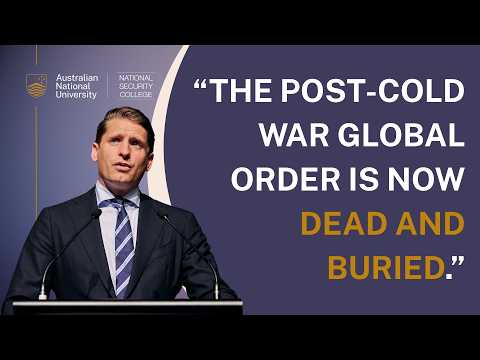
- The conflict in Ukraine has devastated lives and landscapes, prompting critical questions about the nature of modern warfare and its implications for Australia
- There is a growing awareness among Australians regarding national security threats, reflecting an increased recognition of geopolitical challenges
- The collapse of the post-Cold War order has intensified strategic competition, leaving Australia unprepared for emerging global challenges
- The war in Ukraine highlights a broader conflict between democratic and authoritarian regimes, affecting global stability and international relations
- Middle Eastern tensions, especially involving Iran, are contributing to global economic instability, demonstrating the interconnectedness of regional conflicts and their effects on Australia
- Chinas military expansion and potential plans for Taiwan pose significant threats, emphasizing the need for Australia to enhance its defense and strategic capabilities
details
details
details
Read full analysis
- Advocates for abandoning net-zero policies to prioritize energy needs
- Calls for recovering advanced manufacturing capabilities to enhance economic resilience
- Questions the sustainability of relying on fossil fuels for energy security
- Highlights the importance of addressing climate challenges alongside energy needs
- Acknowledges the historical context of Australias military and economic strategies
- Recognizes the shift in public perception regarding national security
- The Strait of Taiwan is becoming increasingly vital for global semiconductor production, highlighting the need for Australia to secure its supply chains for modern technology
- Australias dependence on a just-in-time diesel economy has revealed significant vulnerabilities in energy security, necessitating a reassessment of energy strategies in light of Middle Eastern conflicts
- Decades of offshoring and a focus on raw commodity exports have weakened Australias industrial base, resulting in a decline in economic complexity compared to other OECD nations
- Current economic policies that emphasize decarbonization over industrial strength are leading Australia toward a difficult reckoning regarding its energy and manufacturing sectors
- Australias strategic focus has become too narrow, failing to anticipate the resurgence of great power competition with nations like China, Iran, and Russia, which undermines national security
- A localized defense strategy has left Australia unprepared for modern threats, particularly in safeguarding critical maritime routes, risking national security in a volatile global landscape
details
details
- Australia must embrace re-industrialization and resilience to regain control over its circumstances and lessen reliance on global supply chains
- Prioritizing energy security requires moving away from net zero policies to focus on domestic resources, enhancing independence and reducing vulnerability to global market shifts
- Reviving advanced manufacturing is crucial for building an adaptable economy that can withstand crises, boosting national resilience and promoting job growth
- The current crisis offers a chance for nation-building, similar to past efforts after conflicts, which can unite Australians and instill a renewed sense of purpose
- Disillusionment among young Australians regarding the political and economic landscape highlights the need for tangible improvements in industry and energy security to restore faith in the future
- Global challenges emphasize the importance of a self-sufficient Australia, enabling the nation to confidently navigate potential future disruptions
details
details
The assumption that increased awareness among Australians will lead to effective policy responses overlooks the complexities of national security. Inference: The lack of a clear strategy to address these threats could result in further vulnerabilities, as the geopolitical landscape continues to evolve unpredictably.
This analysis is an original interpretation prepared by Art Argentum based on the transcript of the source video. The original video content remains the property of the respective YouTube channel. Art Argentum is not responsible for the accuracy or intent of the original material.