Climate Change and Weather Patterns in South Africa
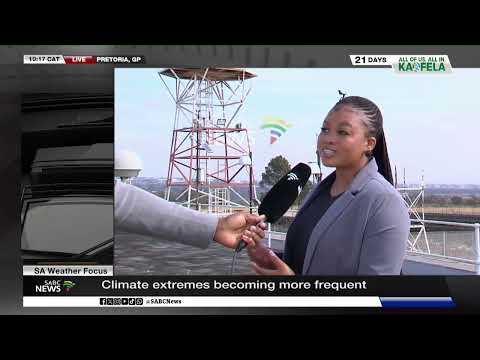
Analysis of climate change impacts on South Africa's weather patterns, based on 'Climate Change | SAWS warns of more inclement weather patterns' | Sabcdigitalnews.
OPEN SOURCESouth Africa is experiencing increasingly erratic weather patterns, including severe storms, flooding, and cold fronts. These events have significantly impacted regions such as the Eastern, Western, Northern Cape, and North West.
Climate change is influencing these weather patterns, with global warming from greenhouse gas emissions causing temperature rises that exceed 1.5 degrees Celsius above pre-industrial levels. The South African Weather Service is analyzing climate scenarios to predict future impacts.
Projections indicate that much of South Africa is becoming drier, particularly in the western areas, while the eastern regions may experience increased rainfall and flooding. This duality presents challenges for water management and agricultural planning.
The combination of drought and flooding complicates food security and necessitates the implementation of climate-smart farming practices. Enhanced resilience in both agriculture and healthcare systems is crucial for adapting to these changes.
Community engagement is essential for raising awareness about climate change impacts, especially in vulnerable regions. Efforts are underway to translate climate information into local languages to improve public understanding.
Modeling by the Weather Service shows a trend of increased dryness in western regions and more rainfall in the east, emphasizing the urgent need to address climate change and its long-term consequences.
- Highlight the urgent need for climate-smart agricultural practices to address flooding and drought
- Emphasize the importance of community engagement and awareness in vulnerable regions
- Question the reliability of climate models in predicting future weather patterns
- Point out the potential impact of urbanization and land use changes on climate predictions
- Acknowledge the dual challenges of increased dryness in the west and flooding in the east
- Recognize the need for improved water management and planning in response to climate change
- South Africa is facing increasingly erratic weather, with severe storms, flooding, and cold fronts impacting the Eastern, Western, Northern Cape, and North West regions
- Climate change is influencing weather patterns, with global warming from greenhouse gas emissions causing temperature rises that exceed 1.5 degrees Celsius above pre-industrial levels
- The South African Weather Service is analyzing climate scenarios to predict future impacts, indicating that much of the country is becoming drier, particularly in the west, while the east may experience more rainfall and flooding
- The combination of drought and flooding presents challenges for water management and agricultural planning, highlighting the need for climate-smart farming practices and enhanced resilience in food security and healthcare
details
- The South African Weather Service highlights the need for community engagement to raise awareness about climate change impacts, especially in vulnerable regions
- To improve understanding of weather warnings, efforts are being made to translate climate information into local languages
- Modeling by the Weather Service, using data from various institutions, shows a trend of increased dryness in western regions and more rainfall in the east of South Africa
- The simultaneous challenges of flooding and drought complicate water management and food security, necessitating better planning and climate-smart agricultural practices
- The rise in global temperatures, now exceeding the 1.5 degrees Celsius threshold, emphasizes the urgent need to address climate change and its long-term consequences
The assumption that climate change is the sole driver of these weather patterns overlooks other potential confounders such as urbanization and land use changes. Inference: The reliance on climate models to predict future scenarios may not account for sudden shifts in weather patterns, which could invalidate current projections. Without addressing these variables, the effectiveness of proposed climate-smart practices remains uncertain.
This analysis is an original interpretation prepared by Art Argentum based on the transcript of the source video. The original video content remains the property of the respective YouTube channel. Art Argentum is not responsible for the accuracy or intent of the original material.