Intel / North America
Real-time monitoring of security incidents, escalation signals and threat indicators across global hotspots, focusing on rapid alerts and emerging risk developments. Topic: North-America. Updated briefs and structured summaries from curated sources.
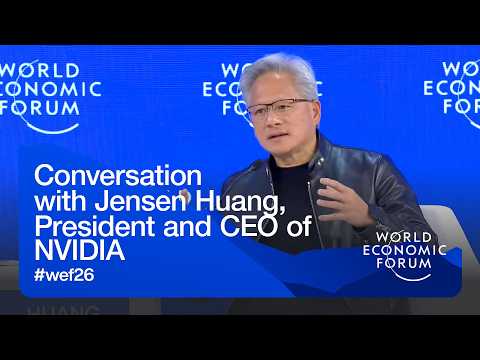
Conversation with Jensen Huang, President and CEO of NVIDIA | WEF Annual Meeting 2026
Summary
Jensen Huang introduces Jetson Wong, praising his leadership at Davidia, which has achieved a compounded total return of 37% since its IPO in 1999, outperforming BlackRock's 21%. Huang emphasizes the importance of AI as a foundational technology that can enhance productivity across various sectors and reshape the global economy.
Huang discusses AI's transformative potential, highlighting its ability to process unstructured information and the significance of the current platform shift in computing. He outlines the five-layer model of AI, which includes energy, chips, cloud infrastructure, AI models, and applications, stressing the unprecedented infrastructure build-out for AI.
The evolution of AI into agentic systems capable of reasoning and planning is discussed, along with breakthroughs in open reasoning models and physical intelligence. Huang counters concerns about job displacement by emphasizing the job creation potential in infrastructure sectors as AI technology advances.
Huang provides examples of how AI has enhanced the efficiency of radiologists and nurses, leading to increased patient throughput and hospital revenues. He argues that AI allows healthcare professionals to focus more on patient care by automating routine tasks.
Perspectives
short
Pro-AI Economic Growth
- Highlights AIs potential to reshape productivity and the global economy
- Emphasizes the unprecedented infrastructure build-out for AI
- Argues that AI enhances job roles rather than displacing them
- Cites examples of AI improving efficiency in healthcare
- Advocates for building AI infrastructure in developing countries
Concerns about Job Displacement
- Raises concerns about the potential for job displacement due to AI
- Questions whether all sectors can adapt to AI equally
- Notes disparities in AI adoption across different regions
- Highlights the need for sufficient investment to realize AIs potential
Neutral / Shared
- Discusses the five-layer model of AI
- Mentions the importance of energy and chip sectors in AI development
- Acknowledges the rapid adoption of AI technologies
Metrics
return
37%
compounded total return for shareholders since IPO
This indicates strong performance and growth potential for investors.
Davidia has total returned for its shareholders. It's been a compounded 30%, 37%.
return
21%
annualized total return for BlackRock
This highlights Davidia's superior performance in comparison to a major financial services company.
the same time BlackRock's annualized total return has been 21%.
valuation
$300 million USD
valuation of Davidia at the time of Huang's stock sale
This reflects the company's market value and Huang's personal financial decision.
I sold and video stock at a valuation of $300 million.
investment
a few hundred billion dollars USD
total investment in AI infrastructure
This level of investment indicates a significant commitment to AI development.
we're now a few hundred billion dollars into it.
vc_funding
one of the largest years in VC funding ever USD
record levels of venture capital funding for AI
High VC funding suggests strong investor confidence in AI's future.
Last year, 2025 was one of the largest years in VC funding ever.
salary_growth
nearly doubled USD
increase in salaries for jobs related to AI and technology
Reflects the rising demand and value of skilled labor in the AI sector.
Salaries have gone up, nearly doubled.
revenue
the revenues of the hospital has gone up USD
hospital revenues due to AI integration
Increased revenues can lead to hiring more staff and improved patient care.
the revenues of the hospital has gone up
staffing
the number of radiologists have gone up units
increase in radiologists due to AI
More radiologists can improve diagnostic capabilities and patient outcomes.
the number of radiologists have gone up
Key entities
Timeline highlights
00:00–05:00
Jensen Huang introduced Jetson Wong at the WEF Annual Meeting 2026, praising his leadership at Davidia. Davidia has achieved a compounded total return of 37% for shareholders since its IPO in 1999, outperforming BlackRock's 21%.
- Jensen Huang, President and CEO of NVIDIA, speaks at the WEF Annual Meeting 2026
- Huang introduces Jetson Wong, highlighting his leadership at Davidia
- Davidia has achieved a compounded total return of 37% for shareholders since its IPO in 1999
- BlackRocks annualized total return is noted at 21%, showcasing Davidias superior performance
- Huang reflects on the impact of Davidias success on pension funds and retirement investments
- He expresses a personal regret about selling Davidia stock to buy a gift for his parents
05:00–10:00
Jensen Huang discusses the transformative potential of AI as a foundational technology that can enhance productivity across various sectors. He emphasizes the importance of ensuring that AI benefits a broad segment of the global economy.
- Jensen Huang emphasizes the transformative potential of AI on the global economy
- AI is positioned as a foundational technology that can enhance productivity across various sectors
- The discussion highlights the importance of ensuring that AI benefits a broad segment of the global economy
- Huang compares the current AI revolution to previous platform shifts, such as the transition to PCs and the internet
- He notes that AI enables real-time processing of unstructured information, unlike traditional software that relies on structured data
- The conversation underscores the need for new applications to be built on top of existing AI technologies like ChatGPT and Anthropic Cloud
10:00–15:00
AI is structured in a five-layer model, with energy, chips, cloud infrastructure, AI models, and applications. The current infrastructure build-out for AI is unprecedented, with hundreds of billions invested and significant growth in energy and chip sectors.
- AI is structured as a five-layer cake, starting with energy at the base, followed by chips, cloud infrastructure, AI models, and finally the application layer
- The application layer is where economic benefits will manifest, impacting sectors like financial services, healthcare, and manufacturing
- The current infrastructure build-out for AI is unprecedented, with hundreds of billions of dollars already invested
- Significant growth is observed in the energy and chip sectors, with companies like TSMC and Foxconn expanding their manufacturing capabilities
- saw record levels of venture capital funding directed towards AI-native companies across various industries
- The dispersion of AI technology is expected to transform sectors such as transportation and science, alongside healthcare
15:00–20:00
Jensen Huang discusses the evolution of AI into agentic systems capable of reasoning and planning, highlighting breakthroughs in open reasoning models and physical intelligence. He emphasizes the potential for job creation in infrastructure sectors as AI technology advances, countering concerns about job displacement.
- Jensen Huang discusses the evolution of language models into agentic AI systems capable of reasoning and planning
- The emergence of open reasoning models, such as Deep Sea, has allowed various sectors to utilize AI for domain-specific applications
- Physical intelligence in AI is advancing, enabling understanding of complex scientific concepts like proteins and quantum physics
- Partnerships, such as with Lilly, highlight AIs potential in drug discovery and protein structure analysis
- Concerns about job displacement due to AI are countered by the belief that AI will create significant job opportunities in infrastructure
- The current infrastructure build-out is expected to generate a variety of skilled jobs, including trades like plumbing and electrical work
20:00–25:00
AI has significantly enhanced the efficiency of radiologists and nurses, leading to increased patient throughput and hospital revenues. The integration of AI allows healthcare professionals to focus more on patient care by automating routine tasks.
- AI has significantly improved the efficiency of radiologists, allowing them to diagnose diseases more effectively
- The integration of AI in radiology has led to an increase in the number of radiologists due to enhanced trust and human interaction
- Hospitals are seeing increased revenues and patient throughput as a result of AIs impact on radiology and nursing
- AI technology is enabling nurses to spend more time with patients by automating charting and documentation tasks
- The purpose of jobs in healthcare, such as radiologists and nurses, is enhanced by AI, which automates routine tasks
- AIs impact on job roles varies globally, with educated societies currently dominating its utilization
25:00–30:00
AI is increasingly recognized as essential infrastructure for all countries, similar to electricity and roads. The rapid adoption of AI, with nearly a billion users, highlights its ease of use and potential to bridge the technology divide in developing nations.
- AI is considered essential infrastructure for every country, akin to electricity and roads
- Countries can leverage local expertise and open models to develop their own AI systems
- AIs ease of use is highlighted as a key factor in its rapid adoption, with nearly a billion users in just a few years
- The cloud has significantly advanced AI capabilities, making it crucial for software companies to engage with it
- ChatGPT is noted as the most successful consumer AI, emphasizing the importance of learning to use AI effectively
- Future AI management will involve both biological and digital versions, integrating them into the workforce