Intel / North America
Real-time monitoring of security incidents, escalation signals and threat indicators across global hotspots, focusing on rapid alerts and emerging risk developments. Topic: North-America. Updated briefs and structured summaries from curated sources.
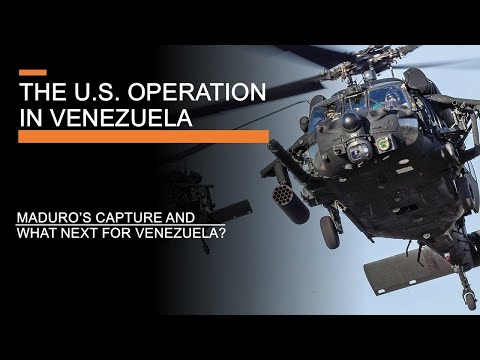
The U.S. Operation in Venezuela - Maduro's Capture & what next for Venezuela?
Summary
In early 2026, U.S. Special Forces executed a rapid operation to capture President Nicolás Maduro in Venezuela. This operation, termed Operation Absolute Resolve, involved significant military assets and showcased the U.S. military's capabilities. The implications of this operation are profound, affecting not only Venezuela but also the broader geopolitical landscape.
The U.S. operation involved tracking and seizing tankers transporting Venezuelan oil, indicating a shift to active military engagement. The operation's success raises questions about the underlying assumptions regarding Venezuela's military capabilities and the potential for U.S. actions to provoke further instability.
Venezuela's military capabilities are significantly outdated, lacking modern radar systems and operational aircraft. The country's air defense is comparable to Ukraine's in 2022, but with fewer resources and questionable readiness, which raises concerns about the effectiveness of U.S. military strategy.
The U.S. executed a helicopter operation to capture Nicolás Maduro, showcasing military readiness and strategic intent. However, the operation's effectiveness is predicated on the assumption that Venezuelan defenses were not only outdated but also inactive during the strikes.
Perspectives
Analysis of the U.S. operation in Venezuela and its implications.
U.S. Government
- Executed a rapid military operation to capture Maduro
- Utilized advanced military assets and strategies
- Aimed to control Venezuelan oil exports for stabilization
- Demonstrated significant technological advantage in military operations
- Assumed that Maduros removal would lead to a stable transition
Venezuelan Government
- Maintained control despite the capture of Maduro
- Sidelined opposition leaders in the aftermath
- Continued to assert legitimacy and resist U.S. influence
- Demonstrated potential for ongoing military capabilities
- Highlighted the risks of U.S. intervention and its consequences
Neutral / Shared
- Operation raised questions about the effectiveness of U.S. military strategy
- Venezuelan military readiness remains uncertain
Metrics
military_assets
USS Gerald R Ford Supercarrier units
U.S. military presence in the region
The presence of significant military assets indicates a shift in U.S. strategy.
the largest warship in the US Navy, the Gerald R Ford Supercarrier
military_assets
40,000 tons
displacement category of wasp class amphibious warfare ships
Indicates the capability of U.S. forces to project power in the region.
about 40,000 tons, as some other nations carriers
military_operations
a couple of hours
time taken for the operation
Demonstrates the rapid response capability of U.S. Special Forces.
just a couple of hours passing between the Go Water being given
military_operations
mid-December months
timing of military positioning
Highlights the strategic buildup leading to the operation.
satellites were clocking the Ford in position between Poiter Rico and Venezuela
military_strategy
actively blockading operations
shift in U.S. strategy towards Venezuelan oil
Indicates a more aggressive U.S. stance in the region.
the US announced that it was going to move from simply sanctioning Venezuelan oil exports to actively blockading them
other
44 for the older S-125 Pershauter units
Venezuelan air defense systems
This adds to the total number of air defense systems available to Venezuela.
around 44 for the older S-125 Pershauter.
other
roughly 5,000 igler-shoulder-fired missiles units
Venezuela's missile inventory
This indicates a potential threat to low-flying aircraft despite overall military weaknesses.
Reuters reported in 2017, for example, that Venezuelan records suggested the country had roughly 5,000 igler-shoulder-fired missiles.
other
a fairly full moon
conditions during the operation
This suggests a calculated risk taken by U.S. forces.
they also went in under a fairly full moon
Key entities
Timeline highlights
00:00–05:00
In early 2026, U.S. Special Forces captured President Nicolas Maduro, highlighting vulnerabilities in Venezuela's military.
- In early 2026, U.S. Special Forces rapidly captured President Nicolas Maduro, revealing vulnerabilities in Venezuelas military readiness
- The U.S. military buildup included significant assets like the USS Gerald R., indicating a shift from sanctions to active blockade of Venezuelan oil
- The operations success may embolden the U.S. to pursue similar actions globally, affecting geopolitical relations
05:00–10:00
The U.S. operation against Maduro involved tracking and seizing tankers transporting Venezuelan oil, indicating a shift to active military engagement.
- The U.S. operation against Maduro involved tracking and seizing tankers transporting Venezuelan oil, indicating a shift to active military engagement
- U.S. Special Operations were heavily concentrated near Venezuela, revealing vulnerabilities in the Venezuelan militarys readiness
- Venezuelas air defense systems, primarily Russian-made, could pose a significant threat to U.S. forces despite their questionable operational status
- The rapid execution of the operation raises questions about the lack of resistance from Venezuelan forces, suggesting a possible pre-arranged outcome
- The operations success may reshape U.S.-Venezuela relations and impact regional stability in Latin America
10:00–15:00
Venezuela's military capabilities are significantly outdated, lacking modern radar systems and operational aircraft. The country's air defense is comparable to Ukraine's in 2022, but with fewer resources and questionable readiness.
- Venezuelas military readiness is questionable, with many aircraft non-operational and a significant gap compared to U.S. forces
15:00–20:00
The U.S. executed a helicopter operation to capture Nicolás Maduro, showcasing military readiness and strategic intent.
- The U.S. executed a helicopter operation to capture Nicolás Maduro, demonstrating military readiness and strategic intent
- General Dan Cain reported extensive surveillance of Maduros habits, indicating thorough preparation
- The operation was trigger-based, aligning with specific conditions like weather and Maduros location
- The U.S. proceeded despite a full moon, reflecting calculated risk tolerance against potential threats
- Final orders were given at 10:46 PM EST, showcasing rapid execution of the plan
- U.S. forces employed various platforms, including the RQ-170 Sentinel drone, to suppress Venezuelan defenses
20:00–25:00
The U.S. executed a multi-domain operation against Venezuelan military capabilities, utilizing cyber warfare and air strikes.
- The U.S. leveraged cyber warfare to disable Venezuelan utilities, marking a shift in multi-domain operations
- Operation Absolute Resolve involved over 150 aircraft, indicating a serious commitment to neutralizing Venezuelan defenses
- U.S. forces targeted Venezuelan air defense systems with AGM-88 anti-radiation missiles
- Satellite imagery confirmed significant damage to a Venezuelan air defense base from U.S. strikes
- The operations planning reflected extensive intelligence on Maduros habits, underscoring its strategic importance
- General Cains precise account enhances understanding of the operations complexities
25:00–30:00
Claims regarding the bombing of Hugo Chavez's Mausoleum were proven false, as the site remained intact after the attack. Russian media exaggerated the extent of damage to Venezuelan military infrastructure, which was minimal and did not incapacitate operational aircraft.
- Claims that the U.S. bombed Hugo Chavezs Mausoleum were false; the site remained intact post-attack
- Russian media exaggerated U.S. strike damage, claiming destruction of military air bases not supported by satellite imagery
- Damage to Venezuelan military infrastructure was minimal; reports indicate operational aircraft remained post-attack
- The U.S. executed precise strikes rather than a comprehensive assault on air defenses, indicating a tactical shift
- New weapon systems, possibly one-way attack drones, were likely employed, marking a change in operational tactics
- The absence of mass cruise missile barrages reflects a focus on targeted strikes rather than overwhelming force