Politics / Brazil
Brazil's Critical Minerals and National Sovereignty
Ronaldo Caiado defended his agreements with the United States and Japan regarding critical minerals in Goiás, countering President Lula's criticism. Caiado emphasized that these agreements aim to develop local technologies and enhance the economic value of Brazil's mineral resources.
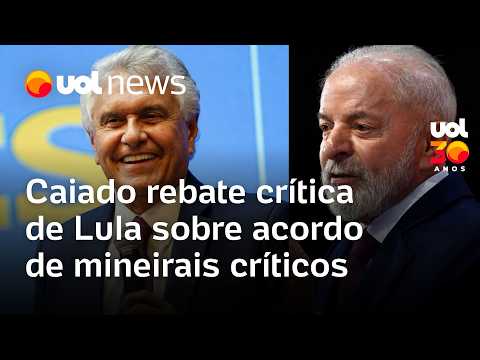
Source material: Caiado responds to Lula about the critical minerals agreement in Goiás: 'He is the one selling Brazil'
Summary
Ronaldo Caiado defended his agreements with the United States and Japan regarding critical minerals in Goiás, countering President Lula's criticism. Caiado emphasized that these agreements aim to develop local technologies and enhance the economic value of Brazil's mineral resources.
Minister Márcio Elias Rosa criticized the memorandum signed by Caiado, asserting that such agreements fall under federal jurisdiction and require legislation to regulate the exploration of critical minerals. Rosa highlighted the necessity for federal oversight to ensure that Brazil's mineral wealth is managed appropriately.
Caiado's response to Lula's comments framed the debate over mineral resources as a matter of national sovereignty. He argued that Brazil must process its rare earth minerals domestically to create jobs and protect its wealth from foreign exploitation.
The conversation underscored Brazil's significant reserves of rare earth elements, which are crucial for high-tech industries and energy transition. Caiado warned against Brazil becoming a mere supplier of raw materials, advocating for strategies that prioritize local processing.
Perspectives
Ronaldo Caiado
- Defends agreements with the U.S. and Japan as essential for local technological development
- Claims Lulas criticism undermines Brazils sovereignty over its mineral resources
President Lula
- Accuses Caiado of selling Brazil by signing agreements without federal consultation
- Emphasizes the need for federal oversight in managing Brazils mineral wealth
Neutral / Shared
- Highlights the importance of critical minerals for Brazils energy transition and economic strategy
- Notes the political implications of the mineral resources debate in the context of upcoming elections
Key entities
Timeline highlights
00:00–05:00
Ronaldo Caiado defended his agreements with the U.S. and Japan regarding critical minerals in Goiás, countering President Lula's criticism.
- Marcio Elias Rosa, the Minister of Development, criticized the memorandum signed by Ronaldo Caiado with the United States regarding rare earth minerals, stating it is unconstitutional as such agreements are under federal jurisdiction
- Rosa highlighted the necessity for legislation to regulate the exploration of critical minerals in Brazil, asserting that the subsoil is owned by the federal government and cannot be appropriated by individual states
- In response to President Lulas criticism of his agreement with the U.S, Caiado claimed that Lula is the one selling Brazil and emphasized that his agreements are intended to foster local technology and industry in Goiás
- The U.S. has expressed intentions to process critical minerals in Brazil, exemplified by USA Rare Earths recent acquisition of a Brazilian rare earth mining company for 14 billion reais, reflecting increasing foreign interest in Brazils mineral resources
- Caiado noted that current exports from Goiás mainly go to China, which leads in refining these elements, and he aims to transition towards exporting refined materials to enhance local economic value
05:00–10:00
Ronaldo Caiado defended his agreements with the U.S. and Japan on critical minerals, emphasizing their role in developing local technologies.
- Ronaldo Caiado, former governor of Goiás, defended his agreements with the United States and Japan on critical minerals, countering President Lulas claim that he acted without federal consultation
- Caiado emphasized that these agreements are designed to develop local technologies and shift exports from raw minerals to refined products, enhancing economic value
- The need for federal oversight in Brazils mineral regulations, as Minister Márcio Elias Rosa called for legislation to manage the extraction of critical minerals
- The issue of mineral sovereignty is politically charged, with both Caiado and Lula using it to bolster their electoral strategies, as Lula has previously warned against foreign exploitation of Brazils resources
- The conversation underscores Brazils significant mineral wealth, particularly in rare earth elements, which are essential for high-tech industries and maintaining global economic competitiveness
10:00–15:00
Ronaldo Caiado defended his agreements with the U.S. and Japan on critical minerals, emphasizing their importance for local technological development.
- The vital role of rare earth minerals in Brazils energy transition and digital sovereignty, advocating for domestic processing to create jobs and safeguard resources
- Caiados response to Lula underscores a conflict between national interests and international pressures, framing the mineral resources debate as a matter of sovereignty against foreign exploitation
- The mention of Flávio Bolsonaros statement suggests that the narrative of selling out Brazil is being politically leveraged, impacting the upcoming elections and economic policy discussions
- There is a warning against Brazil becoming a mere supplier of raw materials, with a call for strategies that prioritize local processing and technological advancement to enhance national wealth