New Technology / Robotics
Track robotics trends, industrial automation, machine intelligence and commercial deployment signals through curated technology summaries.
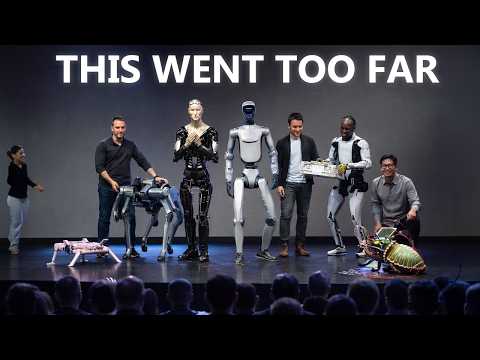
Shocking Light-Powered Robot Runs Without Batteries & Cyborg Cockroach
Topic
Advancements in Robotics
Key insights
- UC Davis developed a light-powered robot that jumps without batteries, performing 188 continuous jumps and showcasing new mechanical intelligence
- The robot uses liquid crystal elastomers that change shape with light, eliminating the need for electronic controls
- It can carry loads up to 1,700 times its weight, utilizing snap through instability for significant tasks
- Professor Wen Zong Yans research focuses on embedding intelligence in materials for operation in challenging environments
- Rice grains can form intelligent metamaterials that adapt their mechanical behavior based on applied force, revolutionizing material science
- Slow compression maintains rices strength, while rapid compression weakens it, allowing for materials that adjust properties under varying conditions
Perspectives
Explores innovative robotics while addressing ethical concerns.
Innovative Robotics Developments
- Describes a light-powered robot that jumps continuously without batteries
- Highlights the use of liquid crystal elastomers for energy storage and release
- Explains how rice grains can form intelligent metamaterials that adapt to stress
- Details the potential applications of tiny robots in environmental monitoring
- Mentions the development of cyborg cockroach swarms for military reconnaissance
Concerns and Ethical Implications
- Questions the robustness of light-powered systems in varying conditions
- Raises ethical concerns about using living organisms for military purposes
- Considers the implications of humanoid robots on employment and societal roles
Neutral / Shared
- Notes the advancements in humanoid robots for industrial applications
- Mentions the testing of robots in real production environments
Metrics
deliveries
188 units
number of continuous jumps performed by the robot
This demonstrates the robot's efficiency and innovative design.
it completed 188 continuous jumps without any electronics at all.
weight_capacity
1,700 times its own body weight times
maximum load the robot can carry
This showcases the robot's remarkable strength relative to its size.
it could still operate while carrying loads up to 1,700 times its own body weight.
weight
300 milligrams
weight of the robot
Its lightweight design is crucial for its jumping ability.
The robot weighs around 300 milligrams, which is basically nothing.
funding
around 13 million euros EUR
total funding raised by Swarm Biotactics
This funding supports the expansion of innovative military technologies.
the startup has raised around 13 million euros
payload
65 kilograms kg
standing payload capacity of Unitree's AS2 robot
This capacity allows the robot to carry significant equipment for missions.
can support a standing payload of 65 kilograms
success_rate
90.2%
Xiaomi's humanoid robot assembly performance
A high success rate indicates effective automation in manufacturing processes.
it achieved a 90.2% success rate while completing each assembly cycle in 76 seconds.
training_time
weeks
Reduction in humanoid robot training time
Shorter training times enhance deployment efficiency in production environments.
This simulation first development approach reduces training time dramatically, shrinking processes that once took months down to just a few weeks.
parameter_count
4.7 billion
Complexity of Xiaomi's vision language action model
A high parameter count suggests advanced capabilities in handling complex tasks.
Xiaomi developed a 4.7 billion-parameter vision language action model combined with reinforcement learning.
Key entities
Timeline highlights
00:00–05:00
UC Davis has developed a light-powered robot that can jump continuously without batteries, achieving 188 jumps by utilizing liquid crystal elastomers. Research on rice grains has revealed their potential to form intelligent metamaterials that adapt their mechanical behavior based on applied force.
- UC Davis developed a light-powered robot that jumps without batteries, performing 188 continuous jumps and showcasing new mechanical intelligence
- The robot uses liquid crystal elastomers that change shape with light, eliminating the need for electronic controls
- It can carry loads up to 1,700 times its weight, utilizing snap through instability for significant tasks
- Professor Wen Zong Yans research focuses on embedding intelligence in materials for operation in challenging environments
- Rice grains can form intelligent metamaterials that adapt their mechanical behavior based on applied force, revolutionizing material science
- Slow compression maintains rices strength, while rapid compression weakens it, allowing for materials that adjust properties under varying conditions
05:00–10:00
Cyborg cockroach swarms are being developed for military reconnaissance, enabling navigation in environments where traditional robots struggle. Unitree's AS2 quadruped robot runs over 5 meters per second, carries 65 kilograms, and operates in harsh conditions.
- Cyborg cockroach swarms are being developed for military reconnaissance, enabling navigation in environments where traditional robots struggle
- Unitrees AS2 quadruped robot runs over 5 meters per second, carries 65 kilograms, and operates in harsh conditions
- Agabots G2 humanoid robot features 26 degrees of freedom for precision tasks in factories, showcasing potential for human-robot collaboration
- Cyborg cockroaches can carry 3 grams of payload, supporting sensors for reconnaissance without weight hindrance
- The AS2 robot operates over 4 hours without a load, crucial for extended field missions
- Cyborg cockroach swarms have been field tested with NATO, indicating real-world military applications
10:00–15:00
Humanoid robots are being tested in various sectors, including automotive assembly and retail assistance, showcasing advanced capabilities and real-time decision-making. The integration of these robots is driven by the need for efficiency and addressing labor shortages in specific industries.
- Agabots humanoid robot, Aeon, is being tested by BMW for battery assembly, showcasing real-time decision-making capabilities
- Xiaomis humanoid robot achieved a 90.2% success rate in installing self-tapping nuts, demonstrating advanced assembly skills
- Honors humanoid robot performed choreographed moves, indicating potential for retail assistance
- Kyoto Universitys Budaroid robot assists in temples, addressing clergy shortages due to Japans aging population
- Simulation environments have reduced humanoid robot training time from months to weeks, enhancing deployment efficiency
- Xiaomis robot adapts to unpredictable conditions during assembly tasks using a complex vision language model