New Technology / Ai Agents
Track AI agents, autonomous workflows, agentic software tools and real-world adoption signals across the next wave of AI products.
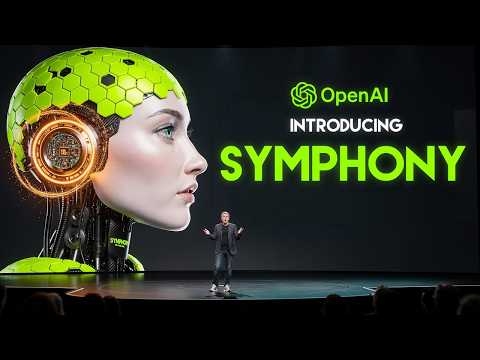
OpenAI Just Dropped Symphony: The First AI That Actually Works
Topic
AI Task Automation
Key insights
- OpenAIs Symphony enables AI agents to autonomously complete coding tasks, shifting AIs role from assistant to independent executor
- Symphony automates task management, streamlining workflows for software teams
- The system creates isolated workspaces for tasks, ensuring AI actions are contained and safe
- AI agents must provide proof of work, including tests and reports, before contributions are accepted
- Upon task completion, AI submits a pull request, integrating its work seamlessly into development processes
- Symphonys AI instructions are stored in Workflow.md, allowing version control alongside code
Perspectives
Overview of AI advancements in task automation.
OpenAI and Xiaomi's Innovations
- Releases Symphony to autonomously complete coding tasks
- Implements isolated workspaces for AI agents to prevent project disruption
- Introduces MiClaw to automate smartphone operations and smart home devices
- Utilizes a context memory system to enhance task management
- Enables dynamic decision-making based on user context and preferences
Microsoft's Multimodal AI Approach
- Develops Phi 4 Vision for efficient multimodal reasoning
- Combines language and vision models to enhance task automation
- Focuses on compact model design to improve performance without excessive resources
- Implements mixed reasoning training to balance perception and reasoning tasks
- Addresses potential failures in perception to improve overall AI effectiveness
Neutral / Shared
- Highlights the importance of structured codebases for AI functionality
- Notes the need for rigorous validation of AI-generated work
- Acknowledges user privacy measures in AI operations
Metrics
other
hundreds of AI coding tasks
the number of tasks Symphony can handle simultaneously
This capability indicates Symphony's scalability and efficiency in managing multiple coding projects.
Symphony can run hundreds of AI coding tasks at the same time
other
more than 1 billion connected devices units
Xiaomi's Mi Home platform
This scale indicates significant market penetration and user reliance on Xiaomi's ecosystem.
Xiaomi says the Mi Home platform already includes more than 1 billion connected devices.
other
about 400 yuan per year CNY
potential savings from subscription analysis
This suggests that the AI can provide valuable financial insights to users.
it might recommend canceling one and estimate savings of about 400 yuan per year.
parameters
15 billion units
number of parameters in Microsoft's Phi 4 Vision model
A lower parameter count can lead to more efficient processing without sacrificing performance.
they built a 15 billion parameter model that focuses on efficiency
tokens
200 billion units
tokens used for training Microsoft's model
The volume of training tokens is crucial for the model's ability to understand and generate multimodal content.
The model was trained on about 200 billion multimodal tokens.
benchmark_score
84.8 score
AI 2D test benchmark score
High benchmark scores indicate strong performance in AI tasks.
Microsoft reports benchmark scores, including 84.8 on AI, 2D, test
benchmark_score
83.3 score
chart QA test benchmark score
This score reflects the model's capability in understanding and analyzing visual data.
83.3 on chart QA, test
benchmark_score
44.9 score
math versus mini benchmark score
Performance in mathematical reasoning is critical for applications requiring analytical skills.
44.9 on math versus mini
Key entities
Timeline highlights
00:00–05:00
OpenAI's Symphony allows AI agents to autonomously complete coding tasks, transforming their role from assistants to independent executors. The system enhances software team workflows by automating task management and ensuring AI actions are contained within isolated workspaces.
- OpenAIs Symphony enables AI agents to autonomously complete coding tasks, shifting AIs role from assistant to independent executor
- Symphony automates task management, streamlining workflows for software teams
- The system creates isolated workspaces for tasks, ensuring AI actions are contained and safe
- AI agents must provide proof of work, including tests and reports, before contributions are accepted
- Upon task completion, AI submits a pull request, integrating its work seamlessly into development processes
- Symphonys AI instructions are stored in Workflow.md, allowing version control alongside code
05:00–10:00
OpenAI's Symphony autonomously manages coding tasks, allowing developers to focus on higher-level work. Xiaomi's MiClaw operates smartphones and smart devices, enabling seamless user task automation.
- OpenAIs Symphony autonomously manages coding tasks, allowing developers to focus on higher-level work
- The system creates isolated workspaces for tasks, ensuring project integrity during automation
- AI agents must provide proof of work, ensuring output meets quality standards
- Symphony integrates AI instructions within the code repository for version control
- Xiaomis MiClaw operates smartphones and smart devices, enabling seamless user task automation
- MiClaw uses a three-level context memory system to track complex tasks effectively
10:00–15:00
OpenAI's Symphony and Xiaomi's MiClaw enhance task automation through AI agents capable of managing coding and user tasks. Microsoft's Phi 4 Vision combines a language model with a vision encoder, focusing on efficient multimodal reasoning.
- OpenAIs Symphony autonomously manages coding tasks, allowing developers to focus on higher-level work and transforming AI into a capable worker
- Xiaomis MiClaw operates smartphones and smart devices, enhancing user task automation with deep system-level integration
- Microsofts Phi 4 Vision combines a language model with a vision encoder, excelling in analyzing text and images for technical applications