Intel / Supply Chain Disruption
Follow supply chain disruption, strategic bottlenecks, logistics pressure and systemic risk signals through structured summaries.
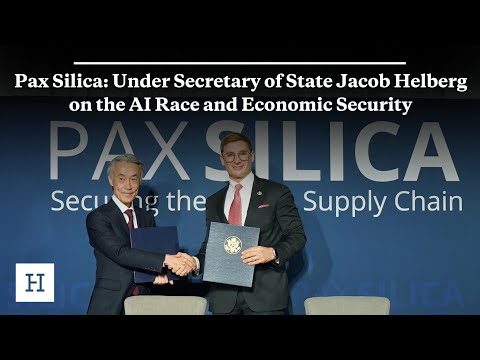
Pax Silica: Under Secretary of State Jacob Helberg on the AI Race and Economic Security
Summary
Under Secretary Jacob Helberg emphasizes the importance of securing supply chains in the AI race, arguing that economic integration does not guarantee geopolitical stability. He highlights the vulnerabilities in the current supply chain, particularly regarding reliance on foreign entities that may not have U.S. interests at heart. Helberg asserts that the Paxilica Initiative aims to create an economic security coalition to address these vulnerabilities.
The Paxilica Initiative focuses on expanding membership to include countries like Qatar, the UAE, and India, while promoting a pro-innovation agenda and securing critical infrastructure. Helberg outlines the initiative's three lines of effort: membership, policy, and projects, emphasizing the need for tangible results rather than mere dialogue.
Helberg discusses the necessity of a vertically integrated approach to supply chains, advocating for deregulation to enhance efficiency and protect sensitive technologies. He stresses the importance of logistics in maintaining industrial competitiveness and ensuring that U.S. companies can operate effectively in a global market.
The Under Secretary critiques the EU's regulatory approach, arguing it stifles innovation and contributes to economic decline. He notes the EU's declining share of global GDP and the need for a shared understanding of sensitive technologies among Paxilica members to enhance economic security.
Perspectives
Analysis of the Paxilica Initiative and its implications for economic security.
Pro-Paxilica Initiative
- Emphasizes the need for securing supply chains in the AI race
- Argues that economic integration does not guarantee geopolitical stability
- Highlights the vulnerabilities in the current supply chain
- Advocates for a vertically integrated approach to supply chains
- Critiques the EUs regulatory approach as stifling innovation
- Stresses the importance of logistics in maintaining industrial competitiveness
Critique of EU and Global Dynamics
- Critiques the EUs regulatory approach as detrimental to its tech sector
- Notes the EUs declining share of global GDP
- Questions the effectiveness of a shared understanding among countries
- Highlights the complexities of international relations
- Expresses concerns about technology leakage and national security
Neutral / Shared
- Discusses the balance between technology sharing and national security
- Acknowledges the complexities of international relations
Metrics
growth
5.4 percent %
current growth rate of the American economy
This growth rate challenges previous predictions of economic decline.
The American economy is growing at a breakneck 5.4 percent.
technology_companies
9 units
largest technology companies by market cap
This highlights the significant role of technology in the American economy.
And nine of them were all technology companies.
expected_membership
India
anticipated new member of Paxillica
India's inclusion could strengthen the coalition's influence.
we look forward to welcoming India next month.
capacity
76%
world's semiconductor manufacturing capacity
This percentage indicates the significant influence of the Pec silica group on global semiconductor production.
we account for roughly, I think it's 76% of the world's semiconductor manufacturing capacity
other
10%
Singapore's semiconductor production
This highlights Singapore's significant role in the global semiconductor supply chain.
Singapore makes 10% of the world's semiconductors
other
GDP, the size of the G20 USD
U.S. companies' contribution to global GDP
This underscores the economic influence of U.S. companies in global supply chains.
the fact that we are home to companies that basically make up a GDP, the size of the G20
GDP share
15%
EU's share of global GDP
A declining GDP share indicates weakening economic influence.
They went from being around almost 60% of global GDP once upon a time, now down to 15%.
growth rate
0 to 1%
EU's growth rate compared to the US
Low growth rates reflect economic stagnation.
they're growing between 0 and 1%, and that's been the case for over a decade.
Key entities
Timeline highlights
00:00–05:00
Jacob Helberg was confirmed as Under Secretary of State for Economic Affairs in October 2025 and launched the Paxilica Initiative in December 2025, which has nine signatory countries. He emphasizes the importance of securing supply chains in the AI race and argues that economic integration does not guarantee geopolitical stability.
- Jacob Helberg was confirmed as Under Secretary of State for Economic Affairs in October 2025
- He launched the Paxilica Initiative in December 2025, which has nine signatory countries
- Helberg emphasizes the shift in global supply chains and their implications for national security
- He argues that economic integration does not guarantee geopolitical stability
- The American economy is currently growing at 5.4 percent, contrary to predictions of decline
- Helberg highlights the importance of securing supply chains in the AI race
05:00–10:00
Under Secretary Jacob Helberg has launched the Paxillica Initiative to form an economic security coalition aimed at addressing vulnerabilities in AI supply chains. The coalition is expanding its membership to include countries like Qatar, the UAE, and India, focusing on securing critical infrastructure and promoting innovation.
- Under Secretary Jacob Helberg emphasizes the need for an economic security coalition called Paxillica to address AI supply chain vulnerabilities
- Paxillica aims to secure critical infrastructure and promote a pro-innovation agenda in AI while protecting sensitive technologies
- The coalition is expanding its membership, recently welcoming Qatar and the UAE, with India expected to join soon
- Helberg highlights the importance of logistics in maintaining industrial competitiveness and plans to replace brittle networks with intelligent systems
- The initiative focuses on strategic partnerships and joint ventures across various sectors, including energy, minerals, and AI infrastructure
- The U.S. aims to export American AI to allies, fostering a competitive ecosystem based on free and fair competition
10:00–15:00
Under Secretary Jacob Helberg emphasizes the need to secure critical minerals and chips to prevent shortages in the AI race. The Pec silica framework aims to enhance collaboration among technologically advanced economies, accounting for approximately 76% of the world's semiconductor manufacturing capacity.
- Under Secretary Jacob Helberg emphasizes the importance of securing critical minerals and chips to prevent shortages
- The Pec silica framework aims to enhance collaboration among technologically advanced economies to secure supply chains
- Helberg highlights the need for innovation, market share, and supply chain security as key components of winning the AI race
- The Pec silica group accounts for approximately 76% of the worlds semiconductor manufacturing capacity
- Policy tools discussed include co-investment, funding, and harmonization of regulatory regimes to support private sector initiatives
- Helberg asserts that the private sector is Americas greatest asset in driving innovation and efficiency
15:00–20:00
Under Secretary Jacob Helberg is advocating for deregulation to improve efficiency in the private sector and enhance the U.S. silicon supply chain.
- Under Secretary Jacob Helberg emphasizes the need for deregulation to enhance efficiency in the private sector
- The U.S. government is collaborating with companies to build a secure silicon supply chain and remove regulatory hurdles
- Helberg notes that many companies lack comprehensive knowledge of their own supply chains, particularly in semiconductor manufacturing
- The conversation around supply chains is framed as an American strategy rather than solely a response to China
- Companies are increasingly recognizing the importance of understanding and managing their supply chain vulnerabilities
- Helberg highlights the critical need for efficient logistics to secure supply chains and access necessary minerals
20:00–25:00
Under Secretary Jacob Helberg is advocating for a shared understanding of sensitive technology and critical infrastructure among signatory countries to enhance economic security. The initiative aims to integrate supply chains with trusted nations while addressing anti-dumping practices and promoting advanced technologies.
- Under Secretary Jacob Helberg emphasizes the importance of a shared understanding of sensitive technology and critical infrastructure among signatory countries
- The framework aims to integrate supply chains with trusted countries to enhance economic security and prevent foreign military ownership of critical ports
- Helberg highlights the need for discussions on anti-dumping practices to support competitive industries in cutting-edge technologies
- The agenda includes proactive projects to leapfrog outdated technologies and improve supply chain efficiency using autonomy and artificial intelligence
- Private sector examples, such as Amazon, illustrate the potential for sophisticated supply chain architectures that predict demand and allocate resources effectively
- Conversations are ongoing about creating a vertically integrated approach to supply chains, moving away from fragmented vendor systems
25:00–30:00
Under Secretary Jacob Helberg emphasizes the importance of a flexible and plurilateral approach to international agreements on economic security. The U.S.
- Under Secretary Jacob Helberg emphasizes the importance of a flexible and plurilateral approach to international agreements on economic security
- The U.S. is viewed as a natural leader in global supply chain discussions, with other countries seeking American involvement
- Helberg highlights the strategic advantages of leveraging unique expertise from different countries, such as Singapores semiconductor production and port logistics
- The U.S. is home to major companies that significantly influence the global supply chain, contributing to its leadership role
- There is a recognition of the need for collaboration among signatories to address policy-related issues effectively
- Helberg expresses a pro-EU stance, countering the perception that the U.S. administration is anti-EU