Canada's Strategic Shift Towards Gulf Partnerships
Analysis of Canada's evolving relationships with Gulf nations, based on 'Canada looks beyond traditional allies to deepen Gulf ties' | The National.
OPEN SOURCECanada is actively seeking to enhance its relationships with Gulf nations, particularly the UAE, by moving beyond traditional alliances with the US and Western countries. The Canadian government emphasizes the importance of building coalitions based on shared values and trust, focusing on areas like intelligence sharing and cybersecurity.
David McGuinty, Canada's Minister of National Defence, highlights the need for midsized countries to collaborate in addressing regional tensions and promoting stability. High-level visits from Canadian officials to the UAE reflect Canada's serious investment in strengthening this bilateral relationship.
Canada is engaged in multinational discussions led by France and the UK to de-escalate tensions in the Gulf, offering its expertise in maritime security and demining. The ongoing regional conflicts have prompted Canada and European nations to reinforce their transatlantic identity, seeking independence from larger powers like the US and China.
The Canadian Armed Forces are undergoing substantial rebuilding and investment, enhancing their equipment and capabilities to take on a more significant role in international defense. The partnership with the UAE is viewed as a model for collaboration, utilizing its strengths in research and military capabilities to deepen ties.
Canada aims to promote peace in the Gulf through dialogue and cooperation among nations to resolve conflicts. The Canadian government remains optimistic about potential peace talks between the US and Iran, advocating for diplomatic solutions over military action.
NATO member states, including Canada, are adjusting their defense strategies and increasing military funding to 5% of GDP in response to global security challenges. The situation in Ukraine remains a critical concern for NATO, underscoring the alliance's commitment to ensuring stability and security against external threats.
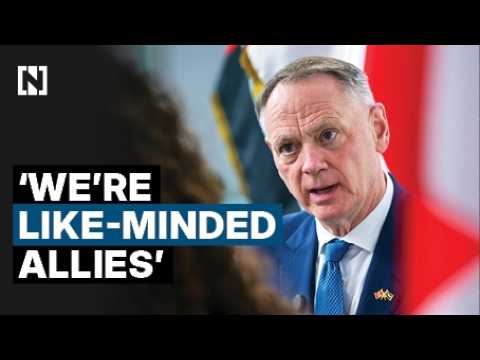
- Emphasizes the importance of building coalitions with Gulf nations based on shared values
- Advocates for diplomatic solutions and de-escalation of tensions in the region
- Concerns about the lack of transparency from the US and Israel regarding military actions
- Canada is committed to enhancing its international presence and reducing reliance on traditional allies
- Ongoing discussions among NATO member states reflect a collective response to global security challenges
- Canada is seeking to enhance its relationships with the UAE and other Gulf nations, moving beyond its traditional alliances with the US and Western countries
- David McGuinty, Canadas Minister of National Defence, highlights the need for midsized countries to form coalitions based on shared values and trust
- The Canadian government is looking into various areas of collaboration with the UAE, such as intelligence sharing, cybersecurity, and maritime security in the Strait of Hormuz
- While Canada is not privy to US and Israeli military actions against Iran, it remains committed to promoting de-escalation and stability in the Gulf region
- High-level visits from Canadian officials to the UAE reflect Canadas serious investment in strengthening this bilateral relationship
details
- Canada is focused on enhancing its relationship with the UAE and other Gulf nations, with an emphasis on collaboration in artificial intelligence, quantum computing, and cybersecurity
- The Canadian government stresses the need for coalitions with like-minded countries to address regional tensions and promote stability, especially in the context of recent conflicts involving Iran
- Canada is engaged in multinational discussions led by France and the UK to de-escalate tensions in the Gulf, offering its expertise in maritime security and demining
- With 60,000 Canadians residing in the UAE, Canada aims to leverage these existing ties for deeper partnerships in research and development
- While Canada supports NATO, it remains flexible regarding participation in collective security efforts, contingent on discussions among member nations about the Gulf situation
details
- Canada is prioritizing the formation of coalitions with mid-sized countries in the Gulf region to strengthen bilateral relationships founded on shared values and trust
- The ongoing regional conflicts have led Canada and European nations to reinforce their transatlantic identity, seeking independence from larger powers like the US and China
- Canada is engaged in multinational discussions, led by France and the UK, aimed at de-escalating tensions in the Gulf, highlighting the significance of regional stability for economic growth and safety
- The Canadian Armed Forces are undergoing substantial rebuilding and investment, enhancing their equipment and capabilities to take on a more significant role in international defense
- The partnership with the UAE is viewed as a model for collaboration, utilizing its strengths in research and military capabilities to deepen ties
- Canada aims to promote peace in the Gulf through dialogue and cooperation among nations to resolve conflicts
- The Canadian government is optimistic about potential peace talks between the US and Iran, advocating for diplomatic solutions over military action
- There is an emphasis on the need for a more democratic and inclusive Iran, particularly regarding human rights issues affecting women, as part of the broader goal for regional stability
- NATO member states, including Canada, are adjusting their defense strategies and increasing military funding to 5% of GDP in response to global security challenges
- The situation in Ukraine remains a critical concern for NATO, underscoring the alliances commitment to ensuring stability and security against external threats
details
The assumption that forming coalitions with Gulf nations will yield stability overlooks the complex geopolitical dynamics at play. Inference: The effectiveness of these alliances may be undermined by the lack of transparency from the US and Israel regarding military actions, which could lead to mistrust among partners. Without addressing these underlying tensions, the proposed collaborations may falter under external pressures.
This analysis is an original interpretation prepared by Art Argentum based on the transcript of the source video. The original video content remains the property of the respective YouTube channel. Art Argentum is not responsible for the accuracy or intent of the original material.