Geopolitic / Asia
Fang Lizhi: A Legacy of Science and Human Rights Advocacy
Fang Lizhi, a prominent astrophysicist and human rights advocate, faced significant political repression in China due to his liberal views. His contributions to science and advocacy for democracy highlight the intersection of intellectual integrity and human rights. Throughout his life, Fang remained committed to scientific inquiry free from ideological constraints, challenging the Communist Party's narrative.
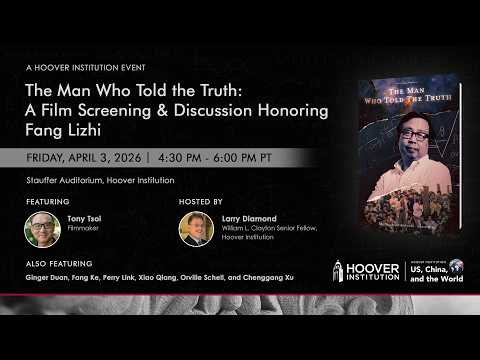
Source material: The Man Who Told The Truth: A Film Screening & Discussion Honoring Fang Lizhi | Hoover Institution
Summary
Fang Lizhi, a prominent astrophysicist and human rights advocate, faced significant political repression in China due to his liberal views. His contributions to science and advocacy for democracy highlight the intersection of intellectual integrity and human rights. Throughout his life, Fang remained committed to scientific inquiry free from ideological constraints, challenging the Communist Party's narrative.
The documentary screening emphasized Fang's resilience during his years in exile, showcasing his dedication to truth and education. His relationship with his wife, Lixu Xian, was portrayed as a vital partnership that supported his advocacy efforts. Fang's legacy continues to inspire younger generations, despite the complexities of state repression and nationalistic sentiments.
Panel discussions revealed Fang's influence on his peers and the ongoing relevance of his ideas in contemporary human rights discourse. His critiques of Marxist ideology and promotion of scientific reasoning contributed to a shift in academic perspectives within China. The event served as a reminder of the importance of dialogue and understanding between different cultural and political groups.
Despite the challenges faced by activists in China today, panelists expressed cautious optimism about the potential for democratic values to resurface. They highlighted the resilience of core values among the Chinese populace, suggesting that societal recovery is possible over time. The conversation underscored the need for continued advocacy and awareness of historical figures like Fang Lizhi.
Perspectives
short
Advocates for Fang Lizhi's Legacy
- Highlights Fangs contributions to science and human rights advocacy
- Emphasizes the importance of his legacy for future generations
Critics of Current Political Climate
- Notes the challenges faced by activists in China today
- Questions the effectiveness of advocacy under current repression
Neutral / Shared
- Acknowledges the historical context of Fangs activism
- Recognizes the ongoing relevance of his ideas in contemporary discussions
Metrics
other
22 years
duration of Fang Lizhi's teaching career at the University of Arizona
This highlights his long-term commitment to education despite exile
He spent the last 22 years of his life as a professor at the University of Arizona.
other
90 years
age of Lixu Xian during the film's production
Her age underscores the enduring legacy of their partnership
Lixu Xian, Feng's wife, is an equal partner in everything they do. She's 90 years old.
other
30 years
duration of time Fang's image remained consistent
This highlights the enduring nature of his dedication to research despite external challenges
the same after 30 years
other
less than 10 years old years
age of Fang's child when he published his first paper
This indicates the early influence of Fang's work on his family
I was only in less than 10 years old
other
40% of people say they have heard about Fang Lizhi, but they're not sure.
Survey results from a young activist's friends regarding knowledge of Fang Lizhi
This indicates a significant gap in historical knowledge among younger generations in China
40% of people say they have heard about the phone each, but they're not sure.
other
40 years
duration of suffering experienced by Tibetan people
This underscores the historical context of Tibetan struggles for equality
Tibetan people have suffered about 40 years already
other
1981
the year Fang Lizhi became a target of the CCP
This marks the beginning of his significant political challenges
So starting from 1981, the CCP single him out as the most prominent target in scientific circles.
Key entities
Timeline highlights
00:00–05:00
The event honored Fang Lizhi, a prominent astrophysicist and human rights advocate, highlighting his contributions and legacy. Speakers acknowledged his struggles against political repression in China and his dedication to scientific integrity and democracy.
- Larry Dynan, a senior fellow at the Hoover Institution, opened the event by highlighting the significance of honoring Fang Lizhi and acknowledging the contributions of the speakers
- Fang Lizhi, a notable astrophysicist and advocate for human rights, faced political repression in China due to his liberal views, particularly during the Cultural Revolution and the Tiananmen Square protests
- Despite facing numerous challenges, Fang achieved remarkable academic success, becoming the youngest member of the Chinese Academy of Sciences in 1980, although his membership was revoked following the 1989 protests
- After the Tiananmen Square crackdown, Fang and his wife sought refuge in the US Embassy for a year before moving to the UK and later the US, where he continued his advocacy for human rights
- Dynan compared Fangs legacy to that of Soviet dissident Andrei Sakharov, emphasizing their shared dedication to scientific integrity and the promotion of human rights
05:00–10:00
Fang Lizhi was a prominent astrophysicist and human rights advocate in China, known for his opposition to political repression and advocacy for democracy. His legacy is marked by his courageous stance against the Communist Party and his contributions to scientific inquiry free from ideological constraints.
- Fang Lizhi, a leading astrophysicist and advocate for human rights in China, faced intense political repression due to his liberal views during significant historical events like the Cultural Revolution and the Tiananmen Square protests
- He argued for scientific inquiry that is independent of Marxist ideology, asserting that genuine scientific advancement relies on individual integrity and passion rather than political conformity
- Fangs activism was highlighted by a crucial open letter to Deng Xiaoping in January 1989, which called for the release of political prisoners and sparked a widespread movement for democracy leading to the Tiananmen protests
- Following the Tiananmen Square crackdown, Fangs membership in the Chinese Academy of Sciences was revoked, reflecting the regimes harsh stance against dissent
- His legacy is characterized by his bravery in opposing the Communist Partys narrative, making him a symbol of the fight for freedom and truth in China, garnering both admiration and criticism
10:00–15:00
The documentary on Fang Lizhi explores his life as an astrophysicist and human rights advocate, emphasizing his experiences during exile. It highlights the challenges he faced and the impact of his legacy on both science and democracy in China.
- Tony Tsoi, the director of the documentary on Fang Lizhi, was motivated by his admiration for Fangs life, particularly during his years in exile, which resonate with Tsois own experiences as an exile
- The film aims to provide a comprehensive view of Fang Lizhis character and legacy, extending beyond his activism in the 1980s to include his time in exile
- Despite lacking prior filmmaking experience, Tsoi was committed to sharing Fangs story, initiating the project by contacting Professor Perry Link, an important figure in Fangs life, through a cold email
- The documentary serves as both a tribute to Fang Lizhi and a personal reflection for Tsoi, highlighting the challenges and resilience associated with the experience of being an exile
15:00–20:00
The event honored Fang Lizhi, a prominent astrophysicist and human rights advocate, highlighting his contributions to science and democracy. The documentary showcased his resilience and commitment to truth during his exile, emphasizing his collaborative relationship with his wife, Lixu Xian.
- Perry Link was instrumental in the films production, providing essential support and connections to the filmmaker despite his initial lack of industry contacts
- The documentary showcases Fang Lizhis humor and dedication to education during his exile, reflecting his resilience and commitment to truth
- Fangs wife, Lixu Xian, is depicted as a vital partner in both his personal and professional life, highlighting their collaborative relationship
- The filmmaker encountered unexpected challenges during the documentarys creation, which revealed a love story intertwined with Fangs life
- Fang Lizhis legacy is marked by his active involvement in human rights organizations in the U.S, underscoring his commitment to advocating for universal values
20:00–25:00
Fang Lizhi was a dedicated physicist whose life was marked by significant turmoil and persecution. Despite these challenges, he remained focused on advancing scientific knowledge rather than engaging in political discourse.
- The speaker highlights Fang Lizhis unwavering dedication to research and education, which persisted despite significant life changes over the past 30 years
- Fangs life was characterized by turmoil and persecution, yet he consistently prioritized his work as a physicist over political discussions
- Childhood memories reveal Fangs early commitment to physics, often depicted writing in a small, hot room
- While Fang made notable contributions to modern relativistic cosmology, many of his students were unaware of his political activism until after his death
- The speaker underscores that Fangs primary motivation was to advance scientific knowledge, distinguishing him as a physicist rather than a politician
25:00–30:00
The documentary highlights Fang Lizhi's significant contributions to both science and human rights advocacy in China. It showcases his resilience in the face of political repression and his lasting impact on future generations of activists.
- Fang Lizhi published his first paper on the Big Bang Theory in 1972, a pivotal year that coincided with the US moon landing, showcasing his boldness in a politically restrictive China
- His research challenged the Marxist perspective on space and time, addressing complex cosmological questions that were considered taboo in the communist regime
- Fangs groundbreaking work received international acclaim, with his findings featured in prestigious journals like Nature, underscoring his significant impact on physics despite the prevailing political climate
- The panel discussion included influential figures inspired by Fang, such as Xiao Zhan, who shifted from physics to human rights advocacy, and Ginger Duan, representing a new generation of activists motivated by Fangs legacy
- The event highlighted the dual significance of Fangs contributions to science and human rights, illustrating the connection between his academic pursuits and his advocacy for democracy