Rethinking Electrical Infrastructure for AI Demands
Analysis of AI infrastructure challenges, based on 'Rethinking the Grid for AI Infrastructure' | Stanford ENERGY.
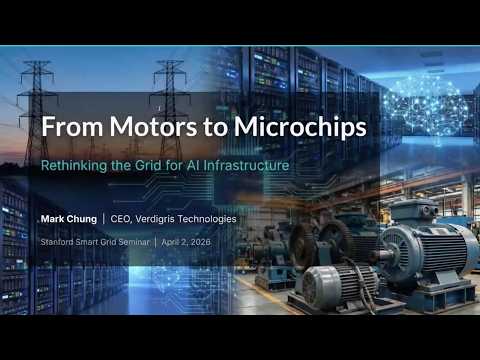
OPEN SOURCEMark Chung, CEO of Verdigris, addresses the disconnect between outdated electrical infrastructure and the requirements of modern AI computing. He emphasizes the importance of real-time electrical intelligence to enhance capacity management and reliability in data centers.
Major tech companies are projected to invest significantly in data centers, with power consumption expected to rise dramatically by 2030. This increase highlights the lag in grid evolution compared to rapid advancements in computing technology.
Despite commitments to achieve net-zero emissions, companies like Google and Meta have experienced substantial increases in carbon emissions since the advent of AI, underscoring challenges in providing clean energy to data centers.
A significant obstacle in expanding data center capacity is the lengthy grid connection process, which can take years, contrasting sharply with the rapid construction timelines of the data centers themselves.
Chung's extensive experience in electrical design and his focus on building electrical intelligence systems aim to improve the observability and reliability of electrical systems in the context of modern AI demands.
- Advocate for real-time telemetry to enhance capacity management in data centers
- Highlight the urgent need for infrastructure upgrades to meet rising power demands
- Point out the inadequacies of legacy systems in handling modern AI workloads
- Emphasize the regulatory and investment challenges that hinder effective upgrades
- Acknowledge the significant investments by tech companies in data center infrastructure
- Recognize the historical context of electrical grid development and its impact on current challenges
- Mark Chung, CEO of Verdigris, discusses the disconnect between outdated electrical infrastructure and the requirements of modern AI computing, stressing the importance of real-time electrical intelligence
- Major tech companies are projected to invest around $600 billion in data centers this year, with power consumption expected to rise significantly by 2030, potentially matching Japans total electricity usage
- Despite commitments to achieve net-zero emissions, companies like Google have experienced a 50% increase in carbon emissions since the advent of AI, highlighting challenges in providing clean energy to data centers
- A significant obstacle in expanding data center capacity is the lengthy grid connection process, which can take up to five years, in stark contrast to the rapid construction timelines of the data centers themselves
- Chung has over 15 years of experience in electrical design and founded Verdigris in 2011, focusing on software and analytics to improve the observability and reliability of electrical systems
details
- The existing electrical infrastructure, primarily designed for industrial motors, struggles to meet the high-density power demands of modern AI data centers, resulting in challenges related to capacity and reliability
- Data centers are expected to consume around 1,000 gigawatts of power by 2030, which is two and a half times their current usage, underscoring the lag in grid evolution compared to rapid advancements in computing technology
- The electrical grid has largely remained unchanged for nearly a century, originally developed to support decentralized power distribution for industrial growth, but it now fails to accommodate the needs of contemporary technology
- The rise of high-performance microprocessors in the 2000s altered power consumption patterns in data centers, yet these facilities have remained largely unmonitored by the existing grid infrastructure until recently
- Efforts to enhance the visibility and management of electrical behavior within facilities are ongoing, but they face complexities that necessitate advanced telemetry and modeling techniques
- The emergence of AI infrastructure has significantly altered electrical load characteristics, similar to the historical influence of electric motors on the grid
- Innovations like Googles transformer architecture have shifted focus towards large GPU clusters, resulting in dramatically increased power demands from data centers
- Initiatives such as OpenAIs Stargate, which aims for 1.2 gigawatts, and Metas Hyperion, projected to consume half of Louisianas grid power, highlight the unprecedented scale of modern computing requirements
- The traditional electrical grid, originally designed for industrial motors, has not adapted to meet the high-density power needs of todays AI and cloud computing environments
- While Moores Law has historically driven computing performance, limitations in Dennard Scaling are complicating efforts to sustain efficiency amid rising power demands
- The transition from traditional CPUs to parallel GPU architectures has transformed computational methods, particularly enhancing matrix operations and neural networks
- This shift poses significant challenges for electrical grids, originally designed for slower, inertia-based loads, as they struggle to meet the rapid, transient demands of modern GPU clusters
- GPUs can rapidly switch states, leading to power demands that can spike from idle to full capacity in microseconds, which legacy systems are not equipped to manage effectively
- The mismatch between high-density computing and outdated electrical infrastructure underscores the need to rethink grid design to support the unique requirements of AI-driven workloads
- The evolution of computing, from vacuum tubes to GPUs, highlights the growing complexity and power demands of modern data centers, which can now rival the power consumption of entire regions
details
- The shift from traditional mechanical loads to high-density GPU clusters poses significant challenges for electrical grids, which were designed with mechanical inertia assumptions that do not apply to modern electronic systems
- GPU clusters can transition from idle to full load in milliseconds, creating rapid power demands that current grid infrastructure struggles to manage, risking instability
- Existing solutions to address these rapid power changes, such as firmware adjustments and energy storage systems, operate independently and lack integration with the grid, leading to inefficiencies
- The increasing reliance on renewable energy sources like solar and wind further complicates grid stability, as these inverter-based systems also lack the inertia provided by traditional thermal generation
- Current power delivery systems in data centers are mismatched with the rapid load changes of modern AI infrastructure, particularly GPU clusters that can shift from idle to full load in milliseconds
- Hardware solutions for managing power fluctuations, such as firmware adjustments and capacitors, lack integration and feedback mechanisms, resulting in inefficiencies in high-density power environments
- The shift to inverter-based renewable energy sources like solar and wind further complicates grid stability, as these systems do not provide the inertia that traditional thermal generation offers
- To effectively align power delivery systems with AI infrastructure, there is a pressing need for high-resolution data sampling, historical data capture, and physics-based modeling to better understand and manage power dynamics
- The existing electrical infrastructure struggles to meet the high-density power requirements of AI, resulting in challenges related to capacity visibility and reliability
- Real-time telemetry and advanced electrical modeling are crucial for aligning traditional power systems with modern AI environments, as current systems lack adequate instrumentation
- Data centers are expected to consume 415 terawatt-hours of electricity in 2024, with projections indicating this could double by 2030 due to the demands of AI applications
- Major technology companies are experiencing rising emissions despite their net-zero commitments, revealing a gap between energy consumption and sustainability initiatives
- Without enhanced electrical intelligence and better communication with the grid, the increasing energy demands of data centers may lead to greater reliance on fossil fuels, jeopardizing climate goals
details
details
details
details
details
details
The assumption that real-time telemetry can bridge the gap between legacy systems and AI demands overlooks potential confounders such as regulatory delays and infrastructure investment disparities. Inference: The reliance on major tech companies to drive change may not account for the variability in their commitment to sustainability. Without addressing these boundary conditions, the proposed solutions may fall short of achieving the necessary energy efficiency.
This analysis is an original interpretation prepared by Art Argentum based on the transcript of the source video. The original video content remains the property of the respective YouTube channel. Art Argentum is not responsible for the accuracy or intent of the original material.