Powering Data Centers in Santa Clara
Analysis of Powering Data Centers in Santa Clara, based on "Presentation | Powering Data Centers in the South Bay | Sustainable Data Centers Symposium" | Stanford ENERGY.
OPEN SOURCESilicon Valley Power, led by Nico Procos, plays a crucial role in supporting data centers in Santa Clara, focusing on reliability, affordability, and innovation. The utility operates within a compact area, managing a peak demand of 746 megawatts and serving 58 data centers, which are integral to the local economy.
Santa Clara boasts a high energy density of approximately 37 megawatts per square mile, significantly surpassing nearby San Jose. This positions Silicon Valley Power as one of the most energy-dense utilities in California, providing competitive electricity rates that benefit both data centers and local residents.
Data center demand in Santa Clara has increased by 7% from fiscal year 2024, reflecting the industry's expanding operations. Silicon Valley Power is investing around $500 million to enhance its infrastructure, including new transmission lines and upgrades to receiving stations, to support this growing load.
The utility has implemented new strategies to manage rapid load growth, including a substation agreement that enhances control over data center load side breakers. This allows for improved power distribution management during contingencies, addressing the unpredictable behavior of energy-intensive loads.
The Flexible Load Interruption Program, developed in partnership with Emerald AI, aims to increase grid flexibility by enabling data centers to adjust their energy loads in real time. This pilot program is designed to be scalable, allowing for specified ramp-ups and ramp-downs to effectively manage energy demands.
- Highlights the importance of reliability, affordability, and innovation in supporting data centers
- Invests significantly in infrastructure to accommodate growing energy demands
- Require increased power commitments and flexibility to manage energy loads
- Face challenges related to unpredictable energy consumption patterns
- Data center demand has increased by 7% from fiscal year 2024
- Silicon Valley Powers energy resource portfolio is primarily green
- Nico Procos, Director of Silicon Valley Power, discussed the utilitys critical role in supporting data centers in Santa Clara, focusing on the need for reliability, affordability, and innovation
- Silicon Valley Power operates within a 20 square mile area, managing a peak demand of 746 megawatts and ranking as Californias third largest municipal utility, with 58 data centers and a growing presence
- Santa Clara boasts a high energy density of approximately 37 megawatts per square mile, significantly surpassing San Joses 7 megawatts per square mile, positioning it among the most energy-dense utilities in California and potentially the U.S
- The average electricity rate for Silicon Valley Power is around $0.15 per kilowatt hour, offering substantial savings for both data centers and local residents compared to many competitors
- Procos noted a historically low growth in energy demand over the past 25 years, which may influence future energy developments in the region
- Silicon Valley Power (SVP) serves Santa Clara, where data centers account for 55% of power usage despite the area representing only 4% of the population
- Data center demand in Santa Clara rose by 7% from fiscal year 2024, reflecting the industrys expanding operations
- SVP is investing around $500 million to enhance its infrastructure, including new transmission lines and upgrades to receiving stations, to support the growing load from data centers
- The utilitys energy resource portfolio is primarily green, incorporating wind, hydro, geothermal, and solar energy, which meets the sustainability standards of the Bay Area
- SVP has formed a robust partnership with the California Independent System Operator (ISO) and the California Energy Commission (CEC) to facilitate reliable transmission planning and infrastructure development
details
details
details
details
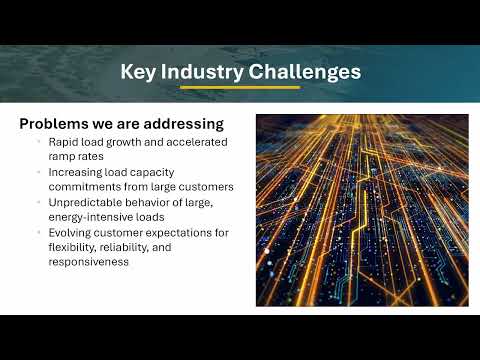
- Data centers are experiencing rapid load growth, requiring increased power and capacity commitments from major customers
- Unpredictable behavior from energy-intensive loads can lead to significant power loss, especially when data centers disconnect during voltage drops
- A new substation agreement enhances control over data center load side breakers, improving power distribution management during contingencies
- The Flexible Load Interruption Program, developed with Emerald AI, aims to increase grid flexibility and accommodate more data centers while managing risks during extreme temperatures
- The electric grids dynamic nature is evolving, indicating that traditional growth management strategies may be inadequate due to the influx of large loads
details
details
- The Emerald platform facilitates real-time communication with data centers, enabling them to adjust compute loads or reduce non-critical loads in response to utility signals, thereby enhancing grid reliability
- A pilot program allows the utility to send signals to data centers for managing energy demands during peak usage, with a curtailment provision as a backup if responses are insufficient
- Data centers participate in the program for increased energy access, although they do not receive direct compensation for their flexibility
- Key features of the program include advanced forecasting, historical analysis of past curtailments, event monitoring, and real-time energy dispatch capabilities
- Currently operating at six megawatts, the pilot program is designed to be scalable, allowing for specified ramp-ups and ramp-downs to effectively manage energy loads
The discussion on energy density assumes that current demand patterns will persist, overlooking potential shifts in technology or policy that could alter energy needs. Inference: The historical low growth in energy demand may not be a reliable predictor of future trends, especially with the rise of AI and data centers. Missing variables include the impact of regulatory changes and advancements in energy efficiency, which could significantly affect both demand and supply dynamics.
This analysis is an original interpretation prepared by Art Argentum based on the transcript of the source video. The original video content remains the property of the respective YouTube channel. Art Argentum is not responsible for the accuracy or intent of the original material.