Politics / United Kingdom
US-Iran Ceasefire Agreement
The U.S. and Iran have reached a conditional two-week ceasefire, contingent upon the safe reopening of the Strait of Hormuz. President Trump announced the suspension of military escalation following discussions with the Pakistani Prime Minister, who acted as a mediator. Iran's Foreign Minister stated that the ceasefire is dependent on halting attacks against Iran.
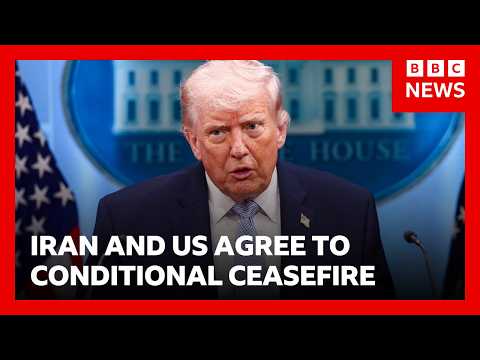
Source material: Iran and US agree to conditional ceasefire and opening of Hormuz strait | BBC News
Summary
The U.S. and Iran have reached a conditional two-week ceasefire, contingent upon the safe reopening of the Strait of Hormuz. President Trump announced the suspension of military escalation following discussions with the Pakistani Prime Minister, who acted as a mediator. Iran's Foreign Minister stated that the ceasefire is dependent on halting attacks against Iran.
Iranian state media claims that the U.S. has accepted a 10-point peace plan proposed by Iran, which includes demands for compensation, lifting sanctions, and a commitment to not pursue nuclear weapons. The Pakistani Prime Minister expressed hope for successful negotiations in Islamabad, emphasizing the need for peace and stability.
Despite the optimistic portrayal of the ceasefire, significant challenges remain. Both nations face a trust deficit, with past negotiations having failed amid escalating conflicts. Iran's military and economic weaknesses complicate its position, as the regime grapples with internal dissent and the need to maintain power.
Negotiations are expected to be difficult, particularly regarding Iran's nuclear program and control over maritime traffic in the Strait of Hormuz. The U.S. has expressed a desire for free traffic, while Iran seeks to assert control, indicating potential points of contention.
Perspectives
short
United States
- Announces suspension of military escalation for two weeks
- Seeks free flow of traffic in the Strait of Hormuz
- Expresses willingness to negotiate despite past failures
Iran
- Claims victory in negotiations with acceptance of 10-point peace plan
- Demands control over maritime traffic in the Strait of Hormuz
- Portrays ceasefire as a means to stabilize internal dissent
Neutral / Shared
- Highlights the role of Pakistan as a mediator in the negotiations
- Notes the mixed public reactions in Iran following the ceasefire announcement
- Acknowledges the ongoing military actions despite the ceasefire agreement
Metrics
ceasefire_duration
two weeks days
duration of the ceasefire agreement
A two-week ceasefire could pave the way for longer-term negotiations.
they have agreed to two weeks he's fired
peace_plan_points
10-point peace plan points
number of points in Iran's peace plan
The complexity of the plan may impact the negotiations' success.
the U.S. has agreed to their 10-point peace plan
executions
one or two executions every day executions
ongoing executions of protestors
This indicates the regime's harsh response to dissent, affecting its stability.
the government has started executing some of those people who were arrested during the protests in January in the past few days, and we've had one or two executions every day.
military_strength
Iran has taken a terrible beating
military situation of Iran
This suggests a weakened negotiating position for Iran.
militarily, Iran has taken a terrible beating.
public_sentiment
mixed reactions
public sentiment in Iran regarding the ceasefire
Mixed feelings could influence future stability and negotiations.
there are mixed reactions.
military_damage
tremendous damage on, for example, the Iranian nuclear program USD
impact of U.S. military actions on Iran's nuclear capabilities
This indicates the extent of U.S. military involvement and its implications for future negotiations.
he's inflicted tremendous damage on, for example, the Iranian nuclear program.
military_damage
destroyed their navy and their air force USD
impact of U.S. military actions on Iran's military capabilities
This highlights the significant military disadvantage Iran faces, affecting their negotiation power.
We've essentially destroyed their navy and their air force.
military_damage
ballistic missile capability has been basically destroyed USD
impact of U.S. military actions on Iran's missile capabilities
This suggests a reduced threat from Iran, influencing U.S. strategic decisions.
Their ballistic missile capability has been basically destroyed.
Key entities
Timeline highlights
00:00–05:00
The U.S. and Iran have agreed to a conditional two-week ceasefire contingent on the safe reopening of the Strait of Hormuz.
- The U.S. and Iran have reached a conditional two-week ceasefire that depends on the safe reopening of the Strait of Hormuz, highlighting the strategic importance of this shipping route
- President Trump announced a halt to military actions against Iran after talks with Pakistans Prime Minister, indicating a significant shift in U.S. foreign policy
- Iranian state media reports that the U.S. has accepted a 10-point peace plan from Iran, which includes demands for lifting sanctions and ceasing hostilities
- Pakistan is actively mediating the situation, inviting both the U.S. and Iran to engage in further discussions in Islamabad
- Irans Supreme National Security Council claims it has met most of its goals in the conflict, portraying the ceasefire as a victory to bolster domestic support
- The upcoming talks in Islamabad are viewed as essential for building trust between the U.S. and Iran
05:00–10:00
The U.S. and Iran are entering a two-week ceasefire, but both sides face significant challenges in negotiations.
- The U.S. and Iran are entering a two-week ceasefire, but both sides face significant challenges in negotiations
- Irans regime, while claiming victory, is grappling with internal dissent and ongoing executions of protestors, indicating a fragile hold on power that may affect their negotiating position
- The U.S. has conditioned the ceasefire on ensuring free maritime traffic through the Strait of Hormuz
- Negotiations will also cover Irans nuclear program, with both sides presenting conflicting demands
- Public sentiment in Iran is mixed; while some feel relief over the ceasefire, fears of regime oppression persist, which could influence future stability
- Military analysts caution that the ceasefire may only result in a temporary halt to hostilities, with the risk of a frozen conflict as previous ceasefires have failed to resolve core issues
10:00–15:00
The U.S. is adapting its strategy to maintain open shipping routes while negotiating with Iran to de-escalate tensions.
- The U.S. is adapting its strategy to maintain open shipping routes, indicating a willingness to negotiate with Iran to de-escalate tensions
- President Trump is pursuing a diplomatic solution, acknowledging Irans ability to withstand military pressure. This approach could lead to a fragile ceasefire, but significant tensions remain unresolved
- Iran may leverage the ceasefire to assert control over the Strait of Hormuz while halting attacks. This complicates negotiations, as both sides have historically struggled to reach consensus
- Despite suffering damage to its military capabilities, Iran has managed to control domestic unrest. This situation underscores the complexities of the conflict and the challenges facing U.S
- Future negotiations are expected to be contentious, with both sides potentially dragging out discussions without a clear resolution. Irans ability to extend talks may allow it to extract concessions from the U.S
- An escalation of the conflict could have led to severe military action from the U.S. and Israel, particularly targeting Irans oil sector