Politics / Poland
Political Dynamics in Poland
Beata Szydło clarified that Law and Justice party members are free to form associations, countering rumors of restrictions. She emphasized that these activities should align with the party's political goals and indicated stability for Mateusz Morawiecki within the party, despite ongoing speculation about his future.
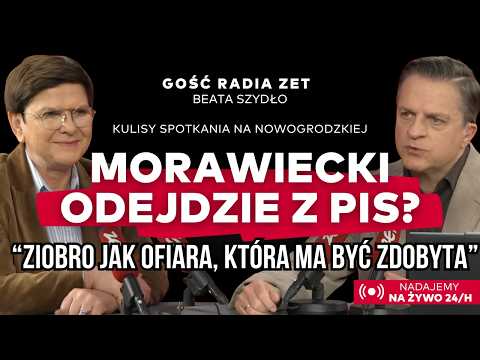
Source material: Szydło o kulisach narady na Nowogrodzkiej. "Ktoś zawalił, podłożył minę prezesowi".Co z Morawieckim?
Summary
Beata Szydło clarified that Law and Justice party members are free to form associations, countering rumors of restrictions. She emphasized that these activities should align with the party's political goals and indicated stability for Mateusz Morawiecki within the party, despite ongoing speculation about his future.
Szydło highlighted the need for the Law and Justice party to adapt its strategies to regain public trust amid declining support. She expressed concerns about the effectiveness of Przemysław Czarnek's candidacy for prime minister and underscored the importance of a unified communication strategy.
Szydło emphasized the importance of collaboration between the president and the government, noting public expectations for a harmonious relationship. She expressed concerns about rising public dissatisfaction and the ruling party's lack of concrete plans ahead of upcoming elections.
Szydło criticized the misuse of national symbols in political discourse and highlighted the need for the Law and Justice party to adapt its strategies to regain public trust. She suggested leveraging Andrzej Duda's experience for future electoral success.
Perspectives
short
Beata Szydło and Law and Justice Party
- Clarifies that party members can form associations without restrictions
- Emphasizes alignment of activities with political goals
- Indicates stability for Morawiecki within the party
- Highlights need for strategic adaptation to regain public trust
- Criticizes misuse of national symbols in politics
- Expresses regret over halted coal power plant construction
Opposition and Public Sentiment
- Questions the effectiveness of current party strategies
- Highlights rising public dissatisfaction with government actions
- Critiques the handling of national symbols and public trust
- Challenges the partys ability to unify diverse voter concerns
- Raises concerns about internal dissent within the party
Neutral / Shared
- Acknowledges the complexities of political dynamics in Poland
- Notes the importance of effective communication strategies
Metrics
support
24%
percentage of support discussed in the context of party dynamics
This figure indicates the current level of public support for the party, which is crucial for electoral strategy.
I invite you to a 24% of our discussion about 76%.
population
38,000 people
number of people involved in a past electoral event
This figure highlights the scale of public engagement in previous elections.
it was about 38,000 people, it was 38,000 people.
Key entities
Timeline highlights
00:00–05:00
Beata Szydło clarified that Law and Justice members are free to form associations, countering rumors of restrictions. She also indicated a stable position for Mateusz Morawiecki and suggested a strategic shift to regain public trust ahead of elections.
- Beata Szydło emphasized that there is no ban on members of Law and Justice from forming associations, countering rumors about restrictions within the party. This clarification suggests that political engagement through various organizations is still encouraged among party members
- Szydło dismissed speculation regarding the potential removal of Mateusz Morawiecki from the party, asserting that there is currently no reason for such an action. Her statement indicates a stable position for Morawiecki within the party despite ongoing discussions
- Commenting on the controversy surrounding Jarosław Kaczyńskis remarks about the Hungarian Prime Minister, Szydło suggested that misinformation led to misunderstandings. She highlighted the need for more careful verification of information among party staff to avoid future missteps
- Szydło described the nomination of Przemysław Czarnek as a candidate for Prime Minister as a unifying move for the party, indicating a strategic shift to regain public trust. This suggests that the party is actively seeking to consolidate its position ahead of upcoming elections
- She expressed the possibility of future alliances with other parties, particularly with the Polish Peoples Party, after the elections. This openness to collaboration reflects a strategic approach to broaden support and enhance political influence
- Regarding President Andrzej Duda, Szydło argued that his contributions should be effectively utilized by the party, implying that his role remains significant in the political landscape. This perspective suggests a continued partnership between the presidency and the partys objectives
05:00–10:00
Beata Szydło clarified that Law and Justice party members are free to form associations, emphasizing that these activities should align with the party's political goals. She indicated stability for Mateusz Morawiecki within the party, despite ongoing speculation about his future.
- Beata Szydło emphasized that there is no ban on members of the Law and Justice party forming associations, asserting that such activities should support the partys political goals. This clarification aims to dispel rumors and reinforce the partys collaborative spirit
- Regarding Mateusz Morawiecki, Szydło stated she sees no reason for him to be expelled from the party, indicating that he remains committed to Law and Justice. This suggests stability within the partys leadership amid speculation about Morawieckis future
- Szydło acknowledged the confusion surrounding Jarosław Kaczyńskis comments about the Hungarian Prime Minister, attributing it to a lack of professional verification of information. She warned that such lapses could undermine the partys credibility and professionalism
- She described Zbigniew Ziobro as being treated as a political scapegoat by the current government, highlighting the challenges he faces. This characterization reflects ongoing tensions within the party and the political landscape in Poland
- Szydło noted that Przemysław Czarneks nomination as a candidate for Prime Minister has unified the party, suggesting a strategic move to regain public trust. This indicates a shift in focus towards consolidating support ahead of upcoming elections
- On the potential for future alliances, Szydło expressed openness to collaborating with other parties, particularly the Polish Peoples Party, after the elections. This indicates a strategic approach to broaden the partys base and enhance its electoral prospects
10:00–15:00
Beata Szydło emphasized the need for the Law and Justice party to adapt its strategies to regain public trust amid declining support. She expressed concerns about the effectiveness of Przemysław Czarnek's candidacy for prime minister and highlighted the importance of a unified communication strategy.
- Beata Szydło stressed that PiS must adapt its strategies to regain public trust, as recent polls indicate a decline in support for the party
- She noted that Przemysław Czarneks nomination as a prime minister candidate has fostered greater internal unity within PiS, but this has not yet improved polling results
- Szydło expressed doubts about the immediate effectiveness of Czarneks candidacy, emphasizing the need for ongoing analysis of the political landscape and tactical adjustments
- She cautioned against alienating voters who may be leaning towards other parties, advocating for a balanced approach that addresses diverse voter concerns while maintaining party cohesion
- When discussing her political ambitions, Szydło minimized her desire to run for prime minister, suggesting that the party should prioritize collective efforts over individual aspirations
- She highlighted the necessity of a clear and consistent message to voters as the campaign approaches, believing that a unified communication strategy is vital for engaging the electorate
15:00–20:00
Beata Szydło highlighted the need for collaboration between the president and the government, emphasizing public expectations for a harmonious relationship. She expressed concerns about rising public dissatisfaction and the ruling party's lack of concrete plans ahead of upcoming elections.
- Beata Szydło emphasized the need for collaboration between the president and the government, highlighting that public expectations are for a harmonious relationship. She noted that current tensions are being exacerbated by the ruling coalitions actions
- Szydło criticized the rhetoric used by the Speaker of the Sejm, suggesting that such language towards the president is unacceptable. This reflects a broader issue of respect and professionalism in political discourse
- She expressed concern over the potential for a new investigative committee regarding government dealings, arguing that it would be a waste of taxpayer money. Szydło believes that the current administration lacks concrete plans and is instead focusing on trivial matters
- Szydło pointed out the growing dissatisfaction among the public regarding health services and rising prices, which could impact the ruling partys popularity. She stressed the importance of addressing these issues to maintain electoral support
- She acknowledged the challenges facing the ruling party, particularly in light of upcoming elections, and emphasized the need for a unified strategy to win. Szydło indicated that forming alliances with other parties could be a viable option post-election
- Szydło warned against the dangers of provoking tensions between the government and the president, suggesting that such actions could undermine their effectiveness. She believes that a cooperative approach is essential for political stability
20:00–25:00
Beata Szydło emphasized the importance of respecting national symbols in political discourse and criticized the misuse of such symbols for political gain. She also highlighted the need for the Law and Justice party to adapt its strategies to regain public trust and suggested leveraging Andrzej Duda's experience for future electoral success.
- Beata Szydło emphasized the importance of respecting national symbols in political discourse, arguing that using such symbols for political gain is inappropriate. This stance highlights the need for mutual respect among different national and social groups
- When asked about Donald Tusk, Szydło suggested that he should focus on the rights of Polish citizens rather than engaging in political games. This reflects a broader call for politicians to prioritize the needs of the public over partisan conflicts
- Szydło expressed that Andrzej Duda should remain an active member of the Law and Justice party, asserting that his contributions were vital to their past electoral success. She believes that leveraging Dudas experience could enhance the partys political strategy moving forward
- The former Prime Minister indicated that the party must adapt its approach to regain public trust, suggesting that they need to play on multiple fronts politically. This strategy could involve forming alliances with other parties to strengthen their position in future elections
- Szydło criticized the recent actions of a member of the Confederation party for disrespecting important national symbols, stating that such behavior is unacceptable. This incident underscores the ongoing tensions within Polish politics regarding respect and representation
- She also mentioned that various initiatives and associations are necessary for the partys growth, advocating for a broader spectrum of activities. This approach could help the party connect better with diverse voter groups and address their concerns
25:00–30:00
Beata Szydło expressed regret over the halted construction of a coal power plant, indicating a need for strategic shifts in energy policy. She emphasized the importance of coalition-building for the Law and Justice party to secure a majority in future elections.
- Beata Szydło expressed regret over the halted construction of a coal power plant, asserting that it should have been completed based on reliable data. This decision reflects a broader issue of energy policy and investment in Polands infrastructure
- Szydło acknowledged the necessity for PiS to form coalitions to govern effectively, especially given the challenges of securing a majority in future elections. This indicates a strategic shift in the partys approach to collaboration with other political entities
- She suggested that discussions with the Polish Peoples Party (PSL) could occur after the next elections, emphasizing the need for cooperation to address Polands current political challenges. This potential alliance could reshape the political landscape if realized
- Szydło highlighted the importance of maintaining a strong position in the upcoming elections to facilitate coalition-building. This underscores the competitive nature of Polish politics and the need for strategic planning
- In response to recent controversies, she noted that criticism of Israels actions should not overshadow the humanitarian crises occurring in the region. This reflects a delicate balance in addressing international issues while maintaining domestic political narratives
- Szydłos comments on the historical significance of Auschwitz suggest a cautious approach to comparisons with current events in Israel. This indicates her awareness of the sensitivities surrounding historical trauma and its implications for contemporary discussions