Politics / Indonesia
NATO and U.S. Military Alliances
President Trump characterizes NATO as ineffective, labeling it a 'paper tiger' that lacks influence in global affairs. He argues that President Putin does not fear NATO but rather the United States, emphasizing the need for stronger U.S. leadership.
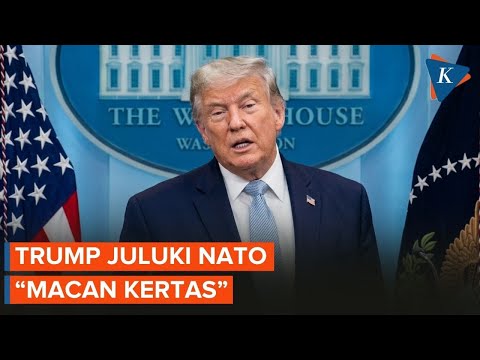
Source material: Trump: NATO Hanya Macan Kertas, Putin Tidak Takut
Summary
President Trump characterizes NATO as ineffective, labeling it a 'paper tiger' that lacks influence in global affairs. He argues that President Putin does not fear NATO but rather the United States, emphasizing the need for stronger U.S. leadership.
Trump expresses frustration with NATO allies for not providing military support during conflicts, particularly in relation to the situation in Iran. He claims that these allies have not only withheld assistance but have also complicated U.S. operations by denying access to necessary resources.
The speech highlights Trump's belief that several countries, including South Korea, Australia, and Japan, have also failed to support U.S. military efforts. He points out the presence of American troops in these nations, suggesting that their reliance on U.S. protection is not reciprocated.
Trump acknowledges that some countries, such as Saudi Arabia and Qatar, have been supportive, but he insists that NATO's overall performance has been disappointing. He reiterates that NATO's lack of assistance during critical times undermines its credibility as a military alliance.
Perspectives
short
Trump's Critique of NATO
- Labels NATO as a paper tiger lacking influence
- Claims Putin fears the U.S. more than NATO
- Accuses NATO allies of not providing military support
- Highlights failures of South Korea, Australia, and Japan to assist
- Points out that NATO has complicated U.S. military operations
- Acknowledges some supportive countries but criticizes NATOs overall performance
NATO's Defense
- Defends NATOs role in global security
- Emphasizes collective defense principles
- Highlights contributions of member states in various conflicts
- Argues for the importance of alliances in deterring aggression
Neutral / Shared
- Mentions the presence of U.S. troops in allied countries
- Notes the geopolitical complexities of military alliances
Metrics
military_presence
50,000 soldiers units
U.S. military presence in Japan
This highlights the U.S. commitment to protecting its allies in the region.
We've got 50,000 soldiers in Japan to protect them from North Korea.
Key entities
Timeline highlights
00:00–05:00
NATO is perceived as ineffective and no longer a significant threat, with President Putin fearing the United States instead. Criticism is directed at NATO allies for their lack of military support during conflicts, raising questions about their reliability.
- NATO is viewed as losing its effectiveness and no longer poses a significant threat to global powers, indicating a decline in its influence
- President Putin is perceived as unthreatened by NATO, instead fearing the United States, which highlights Americas unique position in global affairs
- Frustration is expressed over NATO members failure to support U.S. military operations, particularly during conflicts in Iran
- Criticism is directed at allies like South Korea, Australia, and Japan for not providing military assistance, raising concerns about their reliability
- Some Middle Eastern nations, such as Saudi Arabia and Qatar, are noted for being more supportive than NATO allies, questioning the effectiveness of U.S. partnerships
- The discussion includes a mention of Greenland, reflecting ambitions for territorial expansion that may shape U.S. geopolitical strategies