Politics / Indonesia
Indonesia politics page with daily media monitoring across AntaraTV, Detikcom, Kompascom and Tempo, structured summaries of domestic political developments and a country-level press overview.
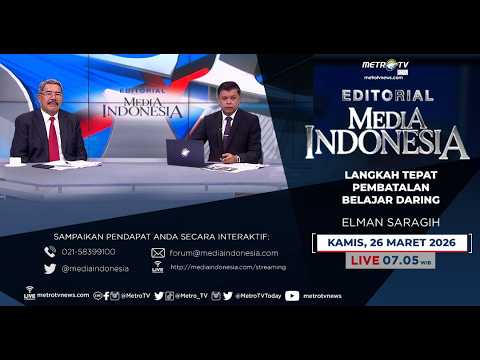
Langkah Tepat Pembatalan Belajar Daring - Bedah Editorial MI
Summary
The government has decided against implementing online learning, emphasizing the importance of physical attendance in schools to combat educational quality degradation. This decision aims to address serious learning loss experienced during the pandemic, which affects both academic skills and social interactions.
The government emphasizes the importance of in-person schooling to prevent educational quality decline and address learning loss. Initiatives are being implemented to improve the overall well-being of students, including health and nutrition support.
The government is prioritizing in-person learning to enhance educational quality and address learning loss. This approach is seen as essential for fostering social skills and character development among students.
The government is prioritizing in-person learning to address significant academic challenges faced by students born during the pandemic. This approach aims to enhance educational quality and ensure students develop essential skills for future competitiveness.
Perspectives
short
Pro In-Person Learning
- Emphasizes physical attendance to combat educational quality degradation
- Addresses serious learning loss experienced during the pandemic
- Highlights the importance of social interactions in educational settings
- Aims to improve overall well-being of students through in-person initiatives
- Focuses on fostering social skills and character development
- Prioritizes in-person learning to enhance educational quality
Concerns Over In-Person Learning
- Assumes in-person learning alone can rectify educational decline
- Neglects critical factors such as resource allocation and teacher training
- Overlooks potential benefits of blended learning models
- Effectiveness hinges on engaging parents and educators meaningfully
Metrics
other
100%
economic growth
Sustained economic growth is crucial for funding educational initiatives.
the economy is growing, it's growing 100%
Key entities
Timeline highlights
00:00–05:00
The government has decided against implementing online learning, emphasizing the importance of physical attendance in schools to combat educational quality degradation. This decision aims to address serious learning loss experienced during the pandemic, which affects both academic skills and social interactions.
- The government has decided against implementing online learning for students, emphasizing the importance of physical attendance in schools. This decision aims to combat the degradation of educational quality
- School attendance is viewed as essential not just for knowledge transfer, but for fostering a social ecosystem among students. The shift back to in-person learning is seen as a necessary step to prevent further learning loss
- The Minister of Education has highlighted the serious learning loss experienced during the pandemic due to remote learning. This loss encompasses not only academic skills but also critical social interactions that shape character and discipline
- President Prabowo Subianto has reiterated the commitment to improving the quality of education for Indonesian children through various initiatives. These programs include free nutritious meals and health checks, aimed at supporting students overall well-being
- While energy efficiency is crucial in light of global crises, it should not overshadow the urgent need to address learning loss. The decline in literacy and numeracy skills poses a significant threat to the nations competitiveness
- The governments firm stance on maintaining in-person schooling is commendable, but it is only the beginning of a broader educational strategy. Schools must evolve into centers of creativity, moving beyond mere curriculum compliance to engage students meaningfully
05:00–10:00
The government emphasizes the importance of in-person schooling to prevent educational quality decline and address learning loss. Initiatives are being implemented to improve the overall well-being of students, including health and nutrition support.
- The decision to maintain in-person schooling is crucial for preventing a decline in educational quality. Physical presence in schools fosters social interaction, which is essential for student development
- The shift back to online learning during the pandemic led to significant learning loss, impacting not just academic hours but also essential social skills. This loss threatens the future competitiveness of the nation
- President Prabowo Subianto has reiterated the governments commitment to improving the quality of education for Indonesian children through various initiatives. These programs aim to address nutritional needs and health checks, which are vital for student well-being
- While energy efficiency is necessary due to global crises, it should not compromise the urgency of addressing learning loss. The decline in literacy and numeracy skills poses a serious risk to the nations future
- The governments decision to continue physical classes is commendable but should be seen as just the beginning. There is a need for innovative teaching methods that engage students beyond mere curriculum compliance
- Schools must adapt to the global energy crisis while ensuring that children receive quality and inclusive education. Balancing educational rights with energy conservation is essential for a sustainable future
10:00–15:00
The government is prioritizing in-person learning to enhance educational quality and address learning loss. This approach is seen as essential for fostering social skills and character development among students.
- The governments choice to continue in-person learning addresses public demand for quality education and is vital for improving the educational system and academic performance
- In-person education is essential for fostering social skills and character development, as remote learning risks disengagement and a lack of life skills
- While a geopolitical crisis may force a return to remote learning, this should only be a last resort, emphasizing the need for stable, quality education
- Engaging with parents and educators is crucial for enhancing face-to-face learning quality, as this builds trust and ensures educational standards are upheld
- Maintaining physical classrooms is critical to preventing further learning loss, as failing to do so could undermine the future capabilities of the nations youth
- Prioritizing quality education alongside energy efficiency is essential for developing a resilient and educated population
15:00–20:00
The government is prioritizing in-person learning to address significant academic challenges faced by students born during the pandemic. This approach aims to enhance educational quality and ensure students develop essential skills for future competitiveness.
- COVID-19 has severely impacted education, especially for those born during the pandemic, who now face significant academic challenges. This situation highlights the urgent need for effective educational strategies to help them catch up
- The government must prioritize in-person learning as the main educational approach, reserving online learning for emergencies only. This is crucial to ensure students receive the full benefits of direct interaction and engagement
- Many students are struggling with fundamental skills like arithmetic, which jeopardizes the nations future competitiveness. Addressing these educational gaps is essential for developing a capable workforce
- Educational policies must focus on maintaining high standards to prevent compromising learning quality. This commitment is vital for nurturing future generations who can contribute effectively to society
- Nutrition and education are closely linked; both need attention to support childrens overall development. Quality education is necessary to maximize the benefits of good nutrition
- In todays unpredictable environment, optimizing learning in schools is essential. Education should continue to inspire hope and provide direction for childrens futures