Politics / Germany
Government Relief Measures in Response to Energy Crisis
The German government has introduced a relief package aimed at alleviating financial burdens on citizens, including a temporary reduction in energy tax and a crisis bonus for employees. These measures are a response to the ongoing energy crisis exacerbated by geopolitical tensions, particularly the Iran conflict. However, the effectiveness of these measures in providing real relief remains uncertain.
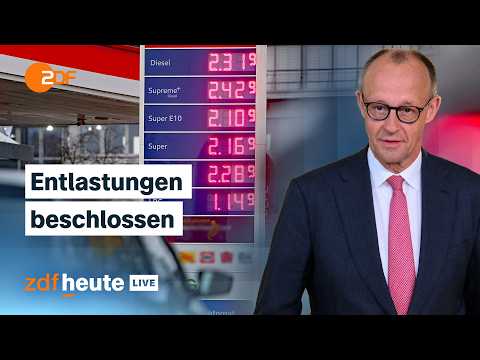
Source material: Tanken günstiger, Bonus vom Chef: Was die Regierung plant und wie es helfen soll | ZDFheute live
Summary
The German government has introduced a relief package aimed at alleviating financial burdens on citizens, including a temporary reduction in energy tax and a crisis bonus for employees. These measures are a response to the ongoing energy crisis exacerbated by geopolitical tensions, particularly the Iran conflict. However, the effectiveness of these measures in providing real relief remains uncertain.
Critics argue that the proposed tax cuts may not directly benefit consumers, as oil companies could absorb the savings instead of passing them on. Additionally, the crisis bonus may not reach those who need it most, particularly low-income individuals and vulnerable groups. The government faces significant pressure to implement broader reforms to address systemic issues in the pension and healthcare systems.
The government is under scrutiny for its approach, which some view as a piecemeal strategy rather than a comprehensive plan. There are concerns that the temporary nature of the measures may lead to further economic instability and public dissatisfaction. The reliance on tax cuts over direct payments has been criticized for failing to address social equity effectively.
Future reforms are anticipated in key areas such as pensions, healthcare, and income tax, with proposals expected in the coming months. The coalition government is navigating internal disagreements, which could impact the implementation of these reforms. Public sentiment is increasingly critical, with calls for more substantial and targeted support.
Perspectives
Analysis of government measures in response to the energy crisis.
Supporters of Government Measures
- Introduce temporary tax cuts to alleviate fuel costs
- Provide crisis bonuses to support employees during the energy crisis
- Aim for broader reforms to address systemic financial issues
Critics of Government Measures
- Criticize the piecemeal approach as inadequate for long-term stability
Neutral / Shared
- Acknowledge the need for significant reforms in pensions and healthcare
- Recognize the pressure on the government to implement effective measures
Metrics
reforms
666 units
number of proposed reforms for the health care system
This indicates a significant effort to overhaul the health care system.
eine ganze Reihe von Vorschlägen für eine Reform des Gesundheitssystems vorgelegt. 666 Stück an der Zahl.
tax_free_bonus
1.000 Euro EUR
tax-free bonus for employees
This measure may not benefit many vulnerable groups, including retirees and students.
die 1.000 Euro oder bis zu 1.000 Euro, die ein Unternehmen an die Beschäftigten steuerfrei auszahlen kann.
cost
10 Milliarden Euro EUR
cost of previous government measures
This highlights the financial burden of government interventions.
Es hat die Bundesregierung damals knapp 10 Milliarden Euro gekostet.
deficit
Defizit im Bundeshaushalt ist riesig EUR
budget deficit
A large deficit could hinder the government's ability to implement reforms.
Defizit im Bundeshaushalt ist riesig oder wird im kommenden Jahren riesig sein.
Key entities
Timeline highlights
00:00–05:00
The German government has introduced measures to alleviate financial burdens, including a temporary reduction in energy tax and a crisis bonus for employees. Critics argue that these measures may not effectively target those in need and could fail to promote sustainable fuel use.
- The German government has agreed on measures to ease financial burdens, including a temporary 17-cent reduction in the energy tax on diesel and gasoline
- Employers can offer a tax-free crisis bonus of 1,000 euros to employees, but participation is optional, as part of a larger reform initiative
- Chancellor Friedrich Merz stated that these measures are the start of ongoing discussions to tackle economic issues, with a focus on swift implementation despite potential delays in formal approval
- There are doubts about whether the tax cut will lead to lower fuel prices at gas stations, with the coalition hoping for stronger regulations to curb unjustified price increases
- Critics from various political groups argue that the relief measures are too generalized and may not effectively assist those most in need, potentially failing to promote sustainable fuel use
- Some organizations, like the ADAC, have supported the governments initiatives, highlighting a split in public and political views on the proposed relief measures
05:00–10:00
The government is under pressure to implement significant reforms in response to financial constraints and an aging population. Key areas for reform include the pension system, health care, and income tax, with proposals expected in the coming months.
- The government faces pressure to implement major reforms due to financial limitations and an aging population, necessitating comprehensive changes across multiple sectors
- Reforms are prioritized in the pension system, health care, and income tax, each requiring immediate strategic planning to address critical challenges
- A commission is developing proposals for the pension systems long-term sustainability, with results due in June to guide the governments reform strategy
- An expert commission has proposed 666 reforms for the health care system, with the health minister aiming to finalize a comprehensive package by summer
- The coalition plans to reduce taxes for middle and lower-income earners by 2027, reflecting a commitment to alleviate financial pressures on these groups
- Despite a compromise on immediate relief measures, ongoing tensions within the coalition indicate potential challenges for future governance
10:00–15:00
The government's recent measures, including a 17-cent tax reduction on fuel, are criticized for being inadequate and potentially counterproductive. Critics argue that these measures may disproportionately benefit oil companies rather than consumers, leaving vulnerable groups without necessary support.
- The recent government measures, including a 17-cent tax reduction on fuel, are seen as inadequate and potentially counterproductive. Critics argue that much of this relief may not reach consumers but instead benefit oil companies with significant market power
- The proposed tax relief for fuel could lead to increased prices in other areas, particularly food, as consumers may not reduce their fuel consumption as needed. This creates a social imbalance, disproportionately affecting low-income individuals who spend a larger portion of their income on essentials
- The plan to allow companies to pay employees a tax-free bonus of up to 1,000 euros is also criticized for its limited reach. Many workers, especially in small businesses, may not benefit from this measure, leaving vulnerable groups like retirees and students without support
- There is a call for more inclusive financial measures that would benefit a broader population, similar to the previous energy cost allowance that reached various demographics. Direct cash payments would allow individuals to allocate funds according to their specific needs, whether for fuel or food
- The current approach is viewed as socially inequitable, failing to address the needs of those most affected by rising costs. A more balanced strategy would ensure that financial assistance is distributed more evenly across different income levels
- Overall, the governments current relief measures are seen as piecemeal and lacking in comprehensive support for those struggling during the energy crisis. A shift towards direct financial aid could provide a more effective solution to the ongoing economic challenges
15:00–20:00
The government has chosen tax measures over direct payments, which may not effectively address social equity and could disadvantage low-income individuals. Critics argue that these temporary solutions risk exacerbating the energy crisis and failing to stabilize the economy.
- The government has opted for tax measures instead of direct payments, which may not effectively address social equity. This approach risks leaving low-income individuals at a disadvantage while benefiting those with more resources
- Subsidizing fuel prices could lead to increased consumption rather than conservation, exacerbating the energy crisis. This could result in higher prices for essential goods, impacting those who rely heavily on food and basic necessities
- Alternative measures, such as implementing speed limits or car-free Sundays, were not considered, despite their potential to reduce consumption. The reluctance to adopt these strategies reflects a lack of political courage to confront uncomfortable truths about resource management
- The governments temporary solutions may create more uncertainty rather than providing clarity for citizens and businesses. A piecemeal approach could lead to confusion and a lack of confidence in the governments ability to manage the crisis effectively
- There is a significant risk that the current measures will fail to stabilize the economy, potentially leading to a recession. Without a comprehensive plan, the government may struggle to prevent job losses and rising unemployment
- The ongoing geopolitical tensions, particularly involving Iran, could further undermine the effectiveness of the governments measures. As the situation evolves, the proposed solutions may quickly become inadequate, necessitating more robust interventions
20:00–25:00
The government is planning to introduce additional measures to address economic challenges, indicating a need for a comprehensive strategy. Public sentiment is increasingly critical of the government's actions, with calls for more substantial support to stabilize the economy.
- The government plans to introduce additional measures to address ongoing economic challenges, indicating a need for a more comprehensive strategy to stabilize the economy
- Public sentiment is growing that the governments current actions are inadequate, with citizens seeking more substantial support to meet their needs
- Chancellor Friedrich Merz characterized the recent measures as the start of a broader reform initiative, suggesting a series of planned actions rather than a one-off response
- The countrys economic stability is jeopardized without a clear funding plan for government initiatives, raising concerns about the sustainability of financial strategies amid a looming budget deficit
- Experts, including Marcel Fratzscher, recommend declaring a state of emergency to facilitate increased borrowing, which could provide necessary funds without raising taxes
- Current measures may fail to stabilize the economy, risking long-term consequences and increasing public dissatisfaction if decisive action is not taken