Politics / Germany
Germany politics page with daily media monitoring, structured summaries of domestic political developments and a country-level press overview built from national political coverage.
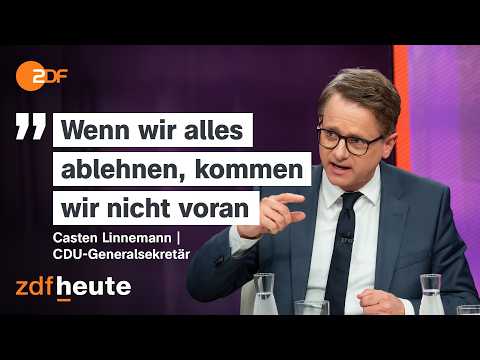
Abstiegsangst im Land – wann liefert Schwarz-Rot? | maybrit illner vom 26. März 2026
Summary
Citizens are expressing growing anxiety over economic decline, prompting demands for reforms from Chancellor Friedrich Merz's administration. The SPD faces significant electoral challenges and must address internal issues to reconnect with voters and stabilize the party's future. The SPD is under pressure to rebuild voter trust after significant electoral losses, emphasizing the need for clearer communication of its core values. Anke Rehlinger highlights the importance of economic strength and social justice as essential for job creation and party relevance.
The Saarland's governance is perceived as effective due to its direct communication with citizens, which is essential for managing expectations during economic transitions. The current government faces significant challenges as declining public trust in political parties risks empowering alternative parties. Boris Palmer emphasizes that political prominence does not guarantee electoral success, highlighting economic challenges in Baden-Württemberg. Recent election data shows a significant shift towards the AfD, indicating voter concerns about the SPD's focus on welfare.
Perspectives
LLM output invalid; stored Stage4 blocks + metrics only.
Metrics
jobs
a thousand jobs units
job losses attributed to economic struggles
Job losses indicate severe economic challenges affecting citizens.
it is worth a week for a thousand jobs
election_results
5.5%
election results in Baden-Württemberg
This indicates a significant electoral challenge for the SPD in that region.
5.5% of the election results are in Baden-Württemberg
election_results
25%
election results in Rheinland-Pfalz
This reflects a critical electoral performance issue for the SPD.
25% of the election results are in Rheinland-Falz
voting_percentage
39%
percentage of workers in Rheinland-Pfalz voting for the AfD
This indicates a significant shift in voter sentiment away from traditional parties.
39% of the work of the company have in Rheinland-Falts. The AfD has been chosen.
voting_percentage
5%
percentage of workers in Baden-Württemberg voting for the SPD
This low percentage highlights the SPD's struggle to connect with voters.
The SPD only has 5% of the work of the company.
perception_percentage
60%
percentage of people perceiving SPD as a transfer performance party
This perception hampers the SPD's ability to attract a broader electorate.
60% of the people, the SPD still has a transfer performance part.
support
one by five percent, one by twenty percent %
shift in political support
Indicates a significant change in voter allegiance.
one by five percent, one by twenty percent
percentage
7.30 percent or to 9.30 percent %
workers in these two countries
Highlights the demographic shift towards the AfD among workers.
7.30 percent or to 9.30 percent who are the workers in these two countries
Key entities
Timeline highlights
00:00–05:00
Citizens are expressing growing anxiety over economic decline, prompting demands for reforms from Chancellor Friedrich Merz's administration. The SPD faces significant electoral challenges and must address internal issues to reconnect with voters and stabilize the party's future.
- Citizens are increasingly anxious about economic decline, intensifying demands for reforms from Chancellor Friedrich Merzs administration as the SPD faces significant electoral setbacks
- Skepticism surrounds the SPDs leadership after recent losses, raising concerns about their ability to reconnect with voters and avoid further marginalization
- The political landscape requires the SPD to take substantial action rather than just changing personnel, especially with upcoming elections that could put pressure on their position
- Anke Rehlinger, the SPDs deputy chair and Minister-President of Saarland, is hesitant to assume additional leadership roles due to her current responsibilities, complicating party dynamics during a critical time
- The SPD must tackle internal challenges beyond leadership changes, as failing to engage with their voter base could have lasting repercussions for the partys future
- There is an urgent need for the government to enact reforms that stabilize the economy and rebuild public trust, with concerns about potential tax increases and budget cuts affecting citizens
05:00–10:00
The SPD is under pressure to rebuild voter trust after significant electoral losses, emphasizing the need for clearer communication of its core values. Anke Rehlinger highlights the importance of economic strength and social justice as essential for job creation and party relevance.
- The SPD faces pressure to rebuild voter trust following significant electoral losses, highlighting the need for clearer communication of its core values
- Anke Rehlinger stresses the importance of economic strength and social justice, asserting that a robust economy is vital for job creation and party relevance
- Leadership acknowledges past communication failures, indicating that a lack of clarity has distanced voters, necessitating a more direct approach to proposed changes
- Rehlinger believes that effectively communicating the SPDs economic policies is essential for improving public perception and boosting approval ratings
- The government is developing a comprehensive reform plan to modernize the social state, which will be crucial for addressing urgent economic challenges
- Despite plans for infrastructure and administrative modernization, the lack of visible results may lead to public frustration if improvements do not occur soon
10:00–15:00
The Saarland's governance is perceived as effective due to its direct communication with citizens, which is essential for managing expectations during economic transitions. The current government faces significant challenges as declining public trust in political parties risks empowering alternative parties.
- The Saarlands governance is viewed as more effective due to its direct communication with citizens, which helps manage expectations during complex economic transitions. This approach is crucial for maintaining public trust amid ongoing changes
- The current government must work together to tackle significant future challenges, as declining public trust in political parties poses a risk of other parties gaining influence. Failure to deliver on promises could exacerbate this distrust
- Clear communication about economic restructuring is vital for sustaining public support for job creation. Politicians must explicitly outline their initiatives to secure and generate jobs in critical sectors like automotive and steel
- Recent electoral wins for the CDU indicate a shift in public sentiment, suggesting that the partys leadership is connecting with voters. This momentum could enable the CDU to advocate for necessary innovations and improvements in labor conditions
- There are concerns about the separation of party leadership from ministerial roles, as this could hinder effective policy implementation. Strong leadership is essential for navigating coalition complexities and ensuring reforms are realized
- Debates on leadership transitions within parties highlight the need for effective leaders in their roles. A strategic approach to leadership changes could revitalize party dynamics and enhance governance
15:00–20:00
Boris Palmer emphasizes that political prominence does not guarantee electoral success, highlighting economic challenges in Baden-Württemberg. Recent election data shows a significant shift towards the AfD, indicating voter concerns about the SPD's focus on welfare.
- Boris Palmer argues that the political prominence of candidates does not guarantee electoral success, emphasizing that substantive issues are more critical. He highlights that Baden-Württemberg is facing significant economic challenges, undermining its previous status as a model region
- Gabriel Felbermayr points out that the coalition government has a financial opportunity to enhance infrastructure and security. However, he warns that the effective use of these resources is crucial for achieving economic stability and public safety
- Recent election data reveals a troubling trend, with a significant portion of workers in Rheinland-Pfalz and Baden-Württemberg voting for the AfD. This shift indicates a growing perception of the SPD as a party primarily focused on welfare, which could put pressure on its political future
- The SPDs struggle to shed its image as a transfer payment party is evident, as many voters still associate it with social welfare issues. This perception hampers the partys ability to connect with a broader electorate concerned about job security and economic stability
- The urgent need for established parties like the SPD and CDU to address the economic fears of voters, particularly regarding job loss and inflation. Failure to do so may result in further erosion of their support base to alternative parties
- The segment underscores the importance of effective communication and policy implementation in restoring public trust in government. As economic conditions worsen, the pressure on the coalition to deliver tangible results intensifies
20:00–25:00
The SPD and CDU are increasingly seen as disconnected from workers' lives, contributing to a rise in support for the AfD. This shift poses a significant challenge for traditional parties that historically represented the working class.
- The SPD and CDU are perceived as increasingly disconnected from the everyday lives of workers, leading to a rise in support for the AfD. This shift indicates a significant challenge for traditional parties that once represented the working class
- Recent comments from politicians, such as the Federal Minister of the Environment suggesting electric cars as a solution to high fuel prices, highlight a lack of understanding of the publics immediate concerns. This disconnect risks further alienating voters who feel their issues are not being addressed
- The SPDs image as a party for workers is deteriorating, with many voters associating it with welfare rather than economic empowerment. This perception could hinder the partys ability to regain trust and support in future elections
- The rise of the AfD as a prominent choice among workers in regions like Baden-Württemberg and Rheinland-Pfalz suggests a shift in political allegiance. This trend poses a serious threat to the established parties, which must adapt to retain their voter base
- The ongoing economic transformation is causing insecurity, particularly among industrial workers, which could lead to increased political volatility. Addressing these economic fears is crucial for any party aiming to stabilize its support
- The current political landscape indicates that traditional strategies may no longer suffice to win back disillusioned voters. Parties need to demonstrate a genuine connection to the electorates struggles and provide tangible solutions to regain their confidence
25:00–30:00
The rise of the AfD is attributed to deindustrialization in regions that were once industrially strong, leading to a disconnect between political actions and public needs. This situation has fostered a demand for more relatable political figures as traditional parties struggle to regain trust from their historical voter base.
- The rise of the AfD is linked to deindustrialization in regions where industry was once strong. This trend indicates a disconnect between political actions and the needs of the populace
- People feel abandoned by the political transformation, leading to a demand for more authentic and relatable political figures. The public is seeking leaders who express genuine thoughts and concerns
- The SPDs long-standing criticism of its own voter base has alienated workers, pushing them towards the AfD. This shift highlights the challenge of regaining trust and support from traditional constituencies
- Current political decisions often exacerbate existing issues, such as labor shortages and bureaucratic inefficiencies. The perception is that the government is failing to provide effective solutions to pressing problems
- There is a pressing need for a reform agenda that addresses the economic challenges faced by communities. Without significant changes, local governments will continue to struggle under financial pressures
- Upcoming elections in the new federal states could see the AfD gaining even more support, raising concerns about political alliances. This situation necessitates a reevaluation of strategies to counteract the AfDs influence