Politics / Germany
Germany politics page with daily media monitoring, structured summaries of domestic political developments and a country-level press overview built from national political coverage.
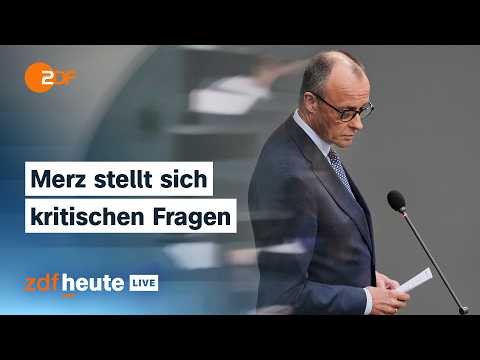
Merz spricht im Bundestag zu Iran, Trump und Reformen | ZDFheute live
Summary
Chancellor Friedrich Merz addressed critical issues in the Bundestag, focusing on the Iran conflict and economic challenges facing Germany. He emphasized the need for reforms in healthcare and social security, highlighting the coalition's pressure to act before the summer break.
The SPD is reassessing its position following recent electoral setbacks, complicating the coalition's governance. Merz stressed the importance of collaboration with the SPD to navigate pressing reform issues and maintain the coalition's majority.
Merz acknowledged that many current problems are self-inflicted and called for a unified approach to resolve them. He emphasized the government's commitment to defense funding amid concerns of financial mismanagement, which is vital for national security.
The Chancellor recognized the urgent need for government action to combat violence against women, particularly in digital spaces. Recent legislative efforts aim to strengthen protections for victims of severe violence and sexual offenses.
Perspectives
Chancellor Merz's address covers a range of domestic and foreign policy challenges, emphasizing the need for reforms and collaboration within the coalition.
Chancellor Merz and Coalition Government
- Emphasizes the need for reforms in healthcare and social security
- Calls for a unified approach to resolve self-inflicted problems
- Stresses the importance of collaboration with the SPD
- Acknowledges the urgent need for action against violence towards women
- Commits to defense funding amid financial concerns
- Recognizes the need for swift reforms before the summer break
Opposition and Criticism
- Questions the effectiveness of proposed reforms
- Critiques the governments handling of financial mismanagement
- Challenges the clarity of the Chancellors proposals
- Raises concerns about the impact of tax cuts on public services
- Highlights the potential for electoral backlash due to inaction
Neutral / Shared
- Discusses the coalitions internal dynamics and pressures
- Mentions the need for cooperation with states on tax policies
- Notes the complexities of inter-coalition negotiations
Metrics
time
30 minutes
duration of discussions with two ministers
This timeframe indicates the urgency and importance of the topics being discussed.
it has been extended to start for 30 minutes
time
90 minutes
duration of discussions with the Chancellor
This extended time reflects the complexity of the issues at hand.
you can ask 90 minutes
time
three times a year times
frequency of Chancellor's meetings
This frequency highlights the limited opportunities for direct accountability.
the Chancellor will come to the meeting three times a year
majority
this coalition has this majority
coalition's governance capability
A stable majority is crucial for enacting reforms.
this coalition has this majority
defense_spending
3.5 percent of our GDP %
NATO obligations for military spending
This reflects Germany's commitment to enhance national security in response to global threats.
we will then have our own distribution restrictions significantly increase and have in our sector the NATO 3.5 percent of our GDP
military_infrastructure
1.5 percent for the military nuclear infrastructure %
Allocation for military infrastructure
This indicates a strategic investment in military capabilities amidst rising global tensions.
1.5 percent for the military nuclear infrastructure
investment_quota
10 percent from the running household %
Investment quota from the current budget
This suggests a significant commitment to public investment, crucial for economic recovery.
the investment quota of 10 percent from the running household
investment_readiness
95 percent of the middle that we are now ready for investments %
Readiness for investments
High readiness indicates potential for economic growth if managed effectively.
95 percent of the middle that we are now ready for investments
Key entities
Timeline highlights
00:00–05:00
Chancellor Friedrich Merz is addressing critical issues in the Bundestag, focusing on the Iran conflict and economic challenges. The coalition faces pressure for reforms in healthcare and social security before the summer break.
- Chancellor Friedrich Merz is set to address critical issues in the Bundestag, including the Iran conflict and economic challenges, which will influence the governments crisis response
- Tension in the Bundestag reflects the urgency for reforms in healthcare and social security, as the coalition faces pressure to act before the summer break
- Merz is likely to focus on international matters, especially concerning Iran and Ukraine, which are expected to dominate his statements and lawmakers inquiries
- The Chancellors ability to handle questions without notes underscores the expectation for him to be knowledgeable about current government policies, promoting accountability
- Discussions will also cover economic reforms, including potential tax and labor law changes, which are vital for revitalizing the economy and addressing social welfare concerns
- The coalitions recent electoral losses contribute to a politically uncertain environment, increasing the need for effective communication and decisive action to maintain public trust
05:00–10:00
The SPD is currently reassessing its position following recent state elections, which poses challenges for the coalition's governance. Chancellor Merz emphasizes the necessity of collaboration with the SPD to navigate pressing reform issues and maintain the coalition's majority.
- The recent state elections have created challenges for the coalition, particularly affecting the SPD, which is currently reassessing its position. This internal conflict may impede effective governance and reform initiatives
- The SPD leadership is committed to participating in reform discussions, seeking to shape the agenda while working alongside the Union. Their influence will be vital for the coalitions effectiveness
- Friedrich Merzs upcoming address is anticipated to clarify the governments reform priorities and explore potential compromises between coalition partners. This could significantly influence future policy negotiations
- The Chancellor stresses the importance of collaborating with the SPD on reform issues to effectively navigate the current political landscape. This partnership is crucial for sustaining the coalitions majority and enacting meaningful policies
- The political climate is tense, with various reform commissions set to present their findings soon. The urgency of these reforms is amplified by the approaching summer deadline, which could affect the coalitions stability
- Merzs speech will tackle major global issues, including conflicts in the Middle East and Ukraine, while also addressing domestic economic stability. The governments approach to these challenges will be critical for Germanys future role in Europe
10:00–15:00
Chancellor Merz emphasized the importance of a strong economy and national defense as critical tasks for the government. He acknowledged that many current problems are self-inflicted and called for a unified approach to resolve them.
- The Chancellor emphasized the need for a strong economy and a defensible Germany as critical tasks for the government during challenging times. This focus is essential for addressing the various issues facing the nation
- He acknowledged that many of the current problems are self-inflicted and stressed the importance of collective efforts to resolve them. A unified approach is necessary to reduce these challenges effectively
- The coalition government, comprising CDU, CSU, and SPD, is expected to work together to find a new consensus on domestic issues. This collaboration is vital for the stability and effectiveness of the government
- The Chancellor highlighted the commitment to significantly increase defense spending in line with NATO obligations. This decision reflects a strategic response to current global threats and aims to enhance national security
- Concerns were raised about the potential misuse of special funds allocated for infrastructure and climate neutrality. The Chancellor defended the governments financial strategies, asserting that a majority of these funds are being used appropriately for investments
- The upcoming questioning session in the Bundestag is designed to hold the Chancellor accountable for his policies and decisions. This process is crucial for transparency and democratic engagement in governance
15:00–20:00
Chancellor Merz emphasized the government's commitment to defense funding amid concerns of financial mismanagement, which is vital for national security. He acknowledged public anxiety over rising energy prices and indicated that while measures are being prepared, immediate relief may not be feasible.
- The Chancellor emphasized the importance of using funds for defense, asserting that the government remains committed to this allocation despite concerns over financial mismanagement. This commitment is crucial for maintaining national security amid rising tensions
- A member of the opposition raised issues regarding the misuse of special funds intended for the military, questioning the governments transparency and accountability. Such allegations could undermine public trust in the governments financial decisions
- The Chancellor acknowledged the publics anxiety over rising energy prices and confirmed that a package of measures is being prepared to address these concerns. However, he cautioned that immediate relief may not be feasible, indicating a need for long-term solutions
- The discussion included proposals for a higher commuter allowance and a windfall tax, which the Chancellor expressed skepticism about due to potential complications in tax law. This highlights the challenges the government faces in balancing fiscal responsibility with public relief efforts
- The Chancellor reiterated that the best way to stabilize prices is to end the ongoing conflict in Iran, emphasizing the governments commitment to diplomatic efforts. This statement underscores the interconnectedness of international relations and domestic economic stability
- The session transitioned to questions from other political factions, indicating a shift in focus towards broader concerns affecting various sectors. This reflects the ongoing political discourse surrounding economic policies and their implications for citizens
20:00–25:00
Chancellor Merz acknowledges the urgent need for government action to combat violence against women, particularly in digital spaces. Recent legislative efforts aim to strengthen protections for victims of severe violence and sexual offenses.
- The Chancellor acknowledges the ongoing discussions about violence against women, particularly in digital spaces. He emphasizes the need for government action to address these concerns and protect victims
- Merz highlights past legislative efforts, including a violence protection law that his party supported when the previous coalition struggled to find consensus. This underscores his commitment to advancing womens rights and safety
- The government has recently approved a bill aimed at strengthening the rights of victims of severe violence and sexual offenses. This legislative move is part of a broader strategy to enhance protections for vulnerable individuals
- Merz calls for collaboration across political factions to support the European Parliaments CSA regulation, which aims to protect children from online violence. This reflects a comprehensive approach to safeguarding both women and children from abuse
- The Chancellor acknowledges the alarming rise in violence within society, both online and offline. He stresses the importance of addressing the root causes of this violence to create a safer environment for all
- Merzs responses indicate a recognition of the urgency surrounding the issue of violence against women. His commitment to legislative action and cross-party collaboration suggests a proactive stance in tackling this societal challenge
25:00–30:00
A significant portion of violence in Germany is attributed to immigrant groups, highlighting the need for a comprehensive understanding of the issue. The government is implementing electronic monitoring for convicted offenders to enhance public safety and address concerns about repeat offenses.
- A significant portion of violence in Germany is attributed to immigrant groups, which is a crucial aspect of the broader issue. Acknowledging this context is essential for a comprehensive understanding of the problem
- The government is implementing electronic monitoring for convicted offenders, allowing for stricter control over their movements. This measure aims to enhance public safety and address concerns about repeat offenses
- There is a pressing need for a unified approach to combat various forms of violence, both online and offline. The state must take a firm stance against all types of violence to maintain internal peace
- Concerns about rising living costs, including rent and fuel prices, are affecting the populations well-being. The government is under pressure to address these economic challenges while maintaining social stability
- The Chancellor emphasized the importance of preserving freedom and peace in Germany, which is vital for the nations future. This commitment reflects the governments responsibility to protect its citizens interests
- The coalition is discussing further reforms to improve the financial situation of households, indicating a proactive approach to economic issues. However, uncertainty remains about potential tax increases, which could impact public sentiment