Intel / Supply Chain Disruption
OSINT intel briefs, structured summaries, and trend signals. Topic: Supply-Chain-Disruption. Updated briefs and structured summaries from curated sources.

Manus on Markets: Nvidia’s blockbuster quarter silences AI sceptics
Full timeline
0.0–300.0
Nvidia reported a 73% year-on-year revenue increase, reaching $68 billion, with a projected guidance of $78 billion for 2026. Data centers contributed significantly, accounting for 91% of sales and generating $62 billion in revenue.
- Dan Eyes described Nvidias fourth quarter results as a drop the mic moment. This reflects his bullish stance on the company
- He believes a capital expenditure boom of $650 billion will continue. This raises questions about whether major tech companies will maintain their investment pace
- Nvidias revenue surged 73% year on year to $68 billion. The projected guidance of $78 billion for 2026 indicates strong growth
- Data centers accounted for 91% of Nvidias overall sales, contributing $62 billion to the revenue. Net income reached an impressive $43 billion
- Despite these strong numbers, concerns linger about potential market bubbles. Supply constraints could also impact future performance
- Jensen Wang emphasized the exponential growth in computing demand. He asserted that customers are eager to invest in AI compute technologies
- The ongoing capital expenditure boom and challenges posed by China remain critical factors. Supply issues also affect Nvidias future outlook

Under Secretary Jacob Helberg on the Pax Silica initiative
Full timeline
0.0–300.0
Pax Silica is a framework designed to enhance semiconductor manufacturing among technologically advanced economies. It aims to secure supply chains and prevent shortages that could hinder AI innovation.
- Pax Silica is a framework uniting technologically advanced economies to enhance semiconductor manufacturing
- The initiative aims to secure supply chains to prevent shortages and slowdowns in AI innovation
- Paxileco countries account for approximately 76% of global semiconductor manufacturing capacity
- The framework facilitates collaboration on increasing production capacity and mineral security
- Key countries involved include South Korea, Japan, and Israel
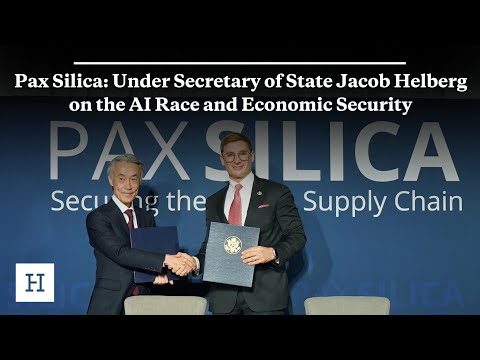
Pax Silica: Under Secretary of State Jacob Helberg on the AI Race and Economic Security
Full timeline
0.0–300.0
Jacob Helberg was confirmed as Under Secretary of State for Economic Affairs in October 2025 and launched the Paxilica Initiative in December 2025, which has nine signatory countries. He emphasizes the importance of securing supply chains in the AI race and argues that economic integration does not guarantee geopolitical stability.
- Jacob Helberg was confirmed as Under Secretary of State for Economic Affairs in October 2025
- He launched the Paxilica Initiative in December 2025, which has nine signatory countries
- Helberg emphasizes the shift in global supply chains and their implications for national security
- He argues that economic integration does not guarantee geopolitical stability
- The American economy is currently growing at 5.4 percent, contrary to predictions of decline
- Helberg highlights the importance of securing supply chains in the AI race
- He notes that all ten of the worlds largest companies by market cap are American, with nine being technology firms
- Helberg attributes the resurgence of the American economy to President Trumps policies
300.0–600.0
Under Secretary Jacob Helberg has launched the Paxillica Initiative to form an economic security coalition aimed at addressing vulnerabilities in AI supply chains. The coalition is expanding its membership to include countries like Qatar, the UAE, and India, focusing on securing critical infrastructure and promoting innovation.
- Under Secretary Jacob Helberg emphasizes the need for an economic security coalition called Paxillica to address AI supply chain vulnerabilities
- Paxillica aims to secure critical infrastructure and promote a pro-innovation agenda in AI while protecting sensitive technologies
- The coalition is expanding its membership, recently welcoming Qatar and the UAE, with India expected to join soon
- Helberg highlights the importance of logistics in maintaining industrial competitiveness and plans to replace brittle networks with intelligent systems
- The initiative focuses on strategic partnerships and joint ventures across various sectors, including energy, minerals, and AI infrastructure
- The U.S. aims to export American AI to allies, fostering a competitive ecosystem based on free and fair competition
- Helberg warns against competing at the lowest margins and advocates for innovation to leverage Americas unique strengths
600.0–900.0
Under Secretary Jacob Helberg emphasizes the need to secure critical minerals and chips to prevent shortages in the AI race. The Pec silica framework aims to enhance collaboration among technologically advanced economies, accounting for approximately 76% of the world's semiconductor manufacturing capacity.
- Under Secretary Jacob Helberg emphasizes the importance of securing critical minerals and chips to prevent shortages
- The Pec silica framework aims to enhance collaboration among technologically advanced economies to secure supply chains
- Helberg highlights the need for innovation, market share, and supply chain security as key components of winning the AI race
- The Pec silica group accounts for approximately 76% of the worlds semiconductor manufacturing capacity
- Policy tools discussed include co-investment, funding, and harmonization of regulatory regimes to support private sector initiatives
- Helberg asserts that the private sector is Americas greatest asset in driving innovation and efficiency
- The government can create incentives and agreements to facilitate private sector actions and remove operational hurdles
- Helberg cites NASA as a historical example of government-led initiatives, contrasting it with the current reliance on private companies for satellite launches
900.0–1200.0
Under Secretary Jacob Helberg is advocating for deregulation to improve efficiency in the private sector and enhance the U.S. silicon supply chain.
- Under Secretary Jacob Helberg emphasizes the need for deregulation to enhance efficiency in the private sector
- The U.S. government is collaborating with companies to build a secure silicon supply chain and remove regulatory hurdles
- Helberg notes that many companies lack comprehensive knowledge of their own supply chains, particularly in semiconductor manufacturing
- The conversation around supply chains is framed as an American strategy rather than solely a response to China
- Companies are increasingly recognizing the importance of understanding and managing their supply chain vulnerabilities
- Helberg highlights the critical need for efficient logistics to secure supply chains and access necessary minerals
- The U.S. aims to provide companies with reliable and competitively priced resources for their supply chains
- There is a growing receptiveness among companies to engage in discussions about supply chain risks and opportunities
- The U.S. is exploring preferential access to markets for minerals with Pax Silica partners
1200.0–1500.0
Under Secretary Jacob Helberg is advocating for a shared understanding of sensitive technology and critical infrastructure among signatory countries to enhance economic security. The initiative aims to integrate supply chains with trusted nations while addressing anti-dumping practices and promoting advanced technologies.
- Under Secretary Jacob Helberg emphasizes the importance of a shared understanding of sensitive technology and critical infrastructure among signatory countries
- The framework aims to integrate supply chains with trusted countries to enhance economic security and prevent foreign military ownership of critical ports
- Helberg highlights the need for discussions on anti-dumping practices to support competitive industries in cutting-edge technologies
- The agenda includes proactive projects to leapfrog outdated technologies and improve supply chain efficiency using autonomy and artificial intelligence
- Private sector examples, such as Amazon, illustrate the potential for sophisticated supply chain architectures that predict demand and allocate resources effectively
- Conversations are ongoing about creating a vertically integrated approach to supply chains, moving away from fragmented vendor systems
- Key project areas identified include building industrial capacity, such as factories and semiconductor fabrication, and modernizing logistics platforms
1500.0–1800.0
Under Secretary Jacob Helberg emphasizes the importance of a flexible and plurilateral approach to international agreements on economic security. The U.S.
- Under Secretary Jacob Helberg emphasizes the importance of a flexible and plurilateral approach to international agreements on economic security
- The U.S. is viewed as a natural leader in global supply chain discussions, with other countries seeking American involvement
- Helberg highlights the strategic advantages of leveraging unique expertise from different countries, such as Singapores semiconductor production and port logistics
- The U.S. is home to major companies that significantly influence the global supply chain, contributing to its leadership role
- There is a recognition of the need for collaboration among signatories to address policy-related issues effectively
- Helberg expresses a pro-EU stance, countering the perception that the U.S. administration is anti-EU
- The conversation around AI and its regulation is a critical area of divergence between the U.S. and the EU
1800.0–2100.0
Under Secretary Jacob Helberg critiques the EU's regulatory approach, arguing it stifles the growth of its tech sector and contributes to economic struggles. He highlights the EU's declining share of global GDP, which has fallen from nearly 60% to 15% over recent decades.
- Under Secretary Jacob Helberg highlights the EUs economic struggles, with growth rates significantly lagging behind the US
- The EUs share of global GDP has decreased from nearly 60% to 15% over the past decades
- Helberg criticizes the EUs regulatory approach, particularly in the tech sector, which hinders the development of European tech giants
- The EUs recent AI regulations are seen as detrimental to the growth of an AI industry in Europe
- There is a growing recognition within the EU of the need to address de-industrialization and unfair competition from Chinese companies
- Helberg expresses hope for constructive dialogue with the EU on economic security, despite significant differences in views on AI and software
- The EUs bureaucratic overreach is exemplified by new directives requiring extensive data reporting from companies across various sectors
2100.0–2400.0
Under Secretary Jacob Helberg discusses the need for the U.S. to balance technology sharing with national security in the AI race.
- Under Secretary Jacob Helberg emphasizes the importance of balancing innovation diffusion with national security concerns in the AI race
- Helberg discusses the need for the U.S. to accept greater risks in sharing technology with allies to maintain a competitive edge
- The concept of decentralizing deterrence is highlighted as a strategy to shift responsibility to allies amidst geopolitical threats
- Helberg notes the trade-off between exporting technology and maintaining a qualitative edge in the market
- The U.S. aims to ensure that technology exports are safeguarded against access by entities of concern
- A trust but verify approach is advocated for evaluating partnerships with countries that may have conflicting interests
- Helberg acknowledges the changing political landscape regarding international business relationships over time
2400.0–2700.0
Under Secretary Jacob Helberg discusses the U.S. strategy to enhance logistics in the supply chain, particularly focusing on semiconductor production and critical minerals sourcing.
- Under Secretary Jacob Helberg emphasizes the importance of logistics in the supply chain strategy
- The U.S. is rapidly advancing in semiconductor production and critical minerals sourcing
- Helberg notes that mobility is essential for a cohesive supply chain strategy
- Countries rich in critical minerals, such as Vietnam and Indonesia, are being considered for partnerships
- The U.S. aims to provide a better alternative to Chinas Belt and Road Initiative
- Helberg highlights the sensitivity of high-end technologies compared to critical minerals
- Conversations are ongoing with various countries regarding Pax Silica-related initiatives
- President Trumps foreign policy is seen as enabling the U.S. strategy in the AI race
2700.0–3000.0
Under Secretary Jacob Helberg discusses the dominance of U.S. companies in global rankings and the significance of tariff policy as a source of economic leverage.
- Under Secretary Jacob Helberg emphasizes the leverage of U.S. companies dominating global rankings
- Helberg highlights the importance of tariff policy as a significant source of economic leverage
- The U.S. accounts for 30% of global consumption despite being only 5% of the worlds consumers
- There is a strategic push for U.S. companies to engage more in African markets, despite lower profit margins
- Helberg notes a high level of admiration for the U.S. president in various countries, particularly in the Gulf and Israel
- The presidents popularity abroad is viewed as a strategic advantage for U.S. foreign relations
- Helberg invites attendees to a future discussion on trade policy with U.S. Trade Representative James Ingrier