Energy / Asia
Track Asia energy trends, demand growth, industrial power needs and strategic supply signals through curated summaries.
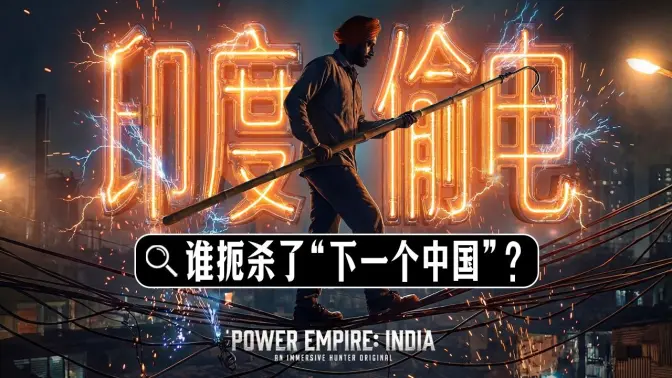
Electric Empire: Why India Can Never Become the World's Factory? A Deep Dive into the Trillion-Dollar Electricity Theft Scam and Monopoly Black Hole of the 'God Oil Country'
Summary
India's electricity sector struggles with high losses and theft, undermining infrastructure development.
The dual-track manufacturing system reveals a disconnect between skilled labor and operational efficiency.
Government measures to mask financial instability raise questions about long-term sustainability.
Reliance on informal practices and political dynamics complicates genuine reform efforts.
Perspectives
The material provides a critical examination of India's electricity sector and its implications for manufacturing.
Challenges in India's Electricity Sector
- Highlight high AT&C losses indicating systemic inefficiencies
- Emphasize reliance on informal electricity theft undermining infrastructure
- Point out the dual-track manufacturing system limiting industrial growth
- Critique government measures that mask financial instability
Government's Response to Electricity Issues
- Implement administrative measures to address financial instability
- Promote renewable energy initiatives despite grid challenges
- Attempt to reform labor laws to encourage business growth
Neutral / Shared
- Acknowledge Indias achievements in space exploration
- Recognize the potential of Indias young workforce
- Note the complexity of integrating renewable energy sources
Metrics
efficiency
6.5 %
manufacturing efficiency in India
Low efficiency rates indicate significant operational challenges for manufacturers.
The manufacturing utilization rate may only be 5% to 8%
loan_interest_rate
12.0 %
interest rates affecting businesses
High loan interest rates limit profitability and sustainability for businesses.
The loan interest rate is 12%
renewable_energy_goal
500.0 GW
India's renewable energy target
Achieving this goal is crucial for energy independence and sustainability.
By 2030, India's renewable energy should reach 500G
solar_component_dependency
85.0 %
dependency on Chinese solar components
High dependency on imports undermines India's manufacturing ambitions.
India relies on China for 80% to 90% of solar components
other
20.0 years
duration of the Subansiri project delays
This highlights significant inefficiencies in project execution.
This project started in 2005, with real interruptions for 20 years.
other
10.0 %
interest rate affecting small and medium enterprises
High interest rates stifle the growth of small businesses.
Loan interest rates can be as high as 10%.
other
100.0 employees
threshold for government approval under the Industrial Disputes Act
This threshold significantly impacts business growth and regulatory compliance.
If a factory has over 100 people, it must get government approval for its finances.
other
300.0 employees
new threshold for government approval attempted in 2002
Raising this threshold was intended to encourage business growth but led to confusion.
This threshold has been raised to 300 people.
Key entities
Timeline highlights
00:00–05:00
On August 23, 2003, India became the fourth country to reach the moon with a budget of $75 million, showcasing its space capabilities. However, the country faces significant challenges in basic infrastructure, particularly in energy supply, highlighting a disparity between its ambitions and reality.
- On August 23, 2003, India became the fourth country to extend its civilization to the moon, achieving this milestone with a budget of only $75 million, lower than many Hollywood productions
- Despite its advancements, India struggles with basic infrastructure, particularly in providing a stable power supply for its space missions, highlighting a contrast between aspirations and reality
- India is often viewed as the next China due to its 1.4 billion young workforce and vast market, but it faces significant challenges in its energy sector
- The widespread use of a technology called Kadi in India, which has a higher penetration rate than smartphones, reflects a cultural adaptation to energy scarcity
- The concept of Jugaad in India represents a unique approach to problem-solving, often involving makeshift solutions that bypass formal systems, termed as frugal innovation by Western scholars
- An example of this is the installation of an LG air conditioner, where the power cord lacks a plug due to safety concerns and the unpredictable voltage range in India
05:00–10:00
India's chip manufacturing sector faces significant challenges due to inconsistent power supply and a culture that prioritizes functionality over precision. Despite these issues, Apple exported $10 billion worth of iPhones from India in 2024, indicating a shift in manufacturing capabilities.
- Chip manufacturing requires strict voltage control and minimal power outages, reflecting a commitment to precision that contrasts with the practices of smaller factories in India
- While large corporations like Apple and Samsung can invest in advanced manufacturing facilities, many smaller Indian factories rely on stolen electricity and informal solutions, leading to inconsistent quality
- The Gubo mentality in India emphasizes functionality over precision, resulting in a manufacturing culture that often neglects strict adherence to quality standards
- In 2024, Apple exported $10 billion worth of iPhones from India, showcasing a shift in manufacturing capabilities despite ongoing challenges related to the Gubo culture
- Indias manufacturing landscape is characterized by a dual-track system, where multinational corporations adhere to high standards while informal factories operate chaotically
- The traditional caste system creates a disconnect in the workforce, as those knowledgeable in engineering often do not engage in hands-on work, resulting in a skills gap
10:00–15:00
In 2024, India's distribution companies faced a significant debt crisis, leading the government to implement measures to mask financial instability. Despite attempts to reduce losses, AT&C losses remain high, indicating systemic issues within the electricity sector.
- In 2024, Indias distribution companies faced a historic debt crisis, prompting the central government to use administrative measures to erase these debts, creating a facade of financial stability
- Despite efforts to reduce losses, Indias AT&C (Aggregate Technical and Commercial) losses remain high, between 15% and 17%, indicating that a significant portion of electricity generated is not billed or collected
- A 2024 study published in the American Economic Review revealed that official electricity consumption figures in certain constituencies were 40% lower than actual usage, suggesting that unaccounted electricity is being used as a political currency to secure votes
- The Modi governments initiative to install 250 million smart meters to combat electricity theft has stalled, with only 20 million installed by early 2025, as these meters would expose long-standing underground political transactions
- To cover the financial shortfall, the Indian government has implemented a cross-subsidy system, charging industrial users 1.5 to 2 times more for electricity than residential users, leading to unsustainable operational costs for factories
- The high industrial electricity prices have driven many manufacturers to establish their own power generation facilities, resulting in a disconnect between the national grid and industrial users, further weakening the electricity system
15:00–20:00
India's electricity distribution companies are experiencing severe financial losses, with high AT&C losses indicating systemic issues. The government's reliance on administrative measures to mask these debts raises concerns about the sustainability of the electricity sector.
- Indias electricity distribution companies are facing significant financial losses, with the government using administrative measures to mask these debts. The AT&C losses remain high at 15% to 17%, indicating a persistent issue where a substantial amount of electricity is unaccounted for
- A 2024 study revealed that official electricity consumption figures in certain constituencies were 40% lower than actual usage, suggesting that electricity is being used as a political currency for votes. This highlights the manipulation of data by distribution companies to conceal the true state of the electricity system
- The Modi governments plan to install 250 million smart meters to curb electricity theft has largely failed, with only 20 million installed by early 2025. The reluctance to implement smart meters stems from fears of exposing long-standing underground political transactions
- To cover financial shortfalls, the Indian government has implemented a cross-subsidy system that charges industrial users significantly higher rates for electricity, often 1.5 to 2 times the residential rates. This pricing strategy places a heavy burden on industries, raising operational costs compared to neighboring countries
- Adanis business model exemplifies monopolistic practices in Indias electricity sector, where infrastructure serves private profit rather than public service. His pricing power allows the transformation of essential energy resources into high-priced financial products, undermining affordability for the general population
- Recent legal changes have allowed Adani to sell electricity back to the domestic market, despite projects being designed for 100% export. This manipulation of regulations illustrates the deep intertwining of monopolistic practices with state machinery, benefiting a few at the expense of the broader economy
20:00–25:00
India's manufacturing sector is struggling with low efficiency rates and high loan interest, which hampers profitability. The electricity crisis, compounded by theft and reliance on intermittent renewable sources, poses significant challenges to the country's industrial ambitions.
- Manufacturing in India faces significant challenges, with many industries operating at a mere 5% to 8% efficiency. High loan interest rates of over 12% mean that businesses often end up working for banks rather than generating profit
- The electricity crisis in India is exacerbated by rampant electricity theft, which prevents the grid from upgrading. This creates a vicious cycle where small and medium manufacturers are caught between high costs and inadequate resources
- Despite ambitious goals to achieve 500 GW of renewable energy by 2030, Indias reliance on intermittent sources like wind and solar creates instability in the power grid. The grid requires a robust system to balance supply and demand, which is currently lacking
- While India has made strides in improving its power infrastructure, the financial health of distribution companies remains precarious. These companies are often underfunded and unable to afford the necessary resources to operate effectively
- The Indian government has attempted to reduce dependence on Chinese solar components, but a significant portion of solar manufacturing still relies on Chinese imports. This shift has merely changed the nature of dependency from finished products to intermediate goods
- Indias strategy to position itself as a global manufacturing hub is undermined by its inability to produce high-purity materials and core components domestically. This reliance on imports continues to hinder Indias manufacturing ambitions
25:00–30:00
India's hydroelectric projects, particularly the Subansiri series, have encountered significant setbacks, revealing challenges in infrastructure development. The country's reliance on intermittent renewable energy sources exacerbates grid instability, highlighting the need for a robust backup system.
- Indias hydroelectric projects, particularly the Subansiri series, have faced numerous setbacks, including structural failures and delays, highlighting the challenges in Indias infrastructure development and engineering capabilities compared to China
- Despite claims of progress in renewable energy, Indias reliance on intermittent sources like solar and wind power creates instability in the grid, necessitating a robust backup system that is currently lacking
- The Indian government has invested heavily in local solar component production, yet the country still depends on China for critical intermediate goods, revealing a shift from finished products to core components without achieving true manufacturing independence
- Indias labor laws impose significant burdens on manufacturers, making it difficult to hire and retain workers, which undermines the potential for industrial growth in a country with a large young population
- High interest rates, unstable power supply, and bureaucratic inefficiencies create a hostile environment for small and medium-sized enterprises, stifling their ability to thrive and contribute to the economy