Politics / Argentina
Argentina politics page with daily media monitoring across Clarincom, Lanacion and Pagina12, structured summaries of domestic political developments and a country-level press overview.
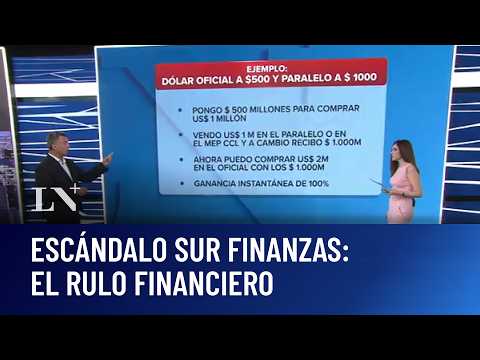
"Rulo cambiario" en Sur Finanzas: la Justicia ordenó 30 allanamientos
Summary
The financial rulo in Argentina illustrates the significant disparity between official and parallel exchange rates, particularly since its establishment in 2011. This disparity reached nearly 200% during the fiscal deficit period of 2020-2021, complicating economic conditions.
Investing in gold has gained attention due to the stark contrast between official and parallel exchange rates. The potential for profit in the parallel market incentivizes individuals to engage in these transactions, often influenced by powerful market figures.
The investigation centers on 35 companies, particularly the Bachejo family, highlighting their connections to the BST bank and financial operations. Recent regulations have complicated access to financial transactions, requiring significant capital for participation.
The discussion highlights the lack of accountability in Argentina's economic management, particularly regarding the central bank and its connections to powerful entities. A significant financial misconduct case involves 124 individuals, including officials and police, linked to a complex web of corruption and drug trafficking.
Perspectives
short
Proponents of Financial Rulo
- Highlight the profit potential in parallel market transactions
- Emphasize the historical context of the financial rulo since 2011
- Point out the significant disparity between official and parallel exchange rates
Critics of Financial Rulo
- Question the transparency and fairness of the financial system
- Critique the reliance on parallel exchange rates as a sign of distrust in official monetary policy
- Condemn the involvement of powerful entities in financial misconduct
Neutral / Shared
- Acknowledge the complexity of financial regulations affecting market access
- Recognize the involvement of multiple parties in the financial misconduct investigation
Metrics
percentage_difference
200%
disparity between official and parallel exchange rates in 2023
This high percentage indicates severe economic instability and challenges for businesses.
2023, 200%
percentage_difference
160%
disparity between official and parallel exchange rates in 2022
This reflects ongoing economic challenges and the impact of fiscal policies.
2022, 160%
capital_requirement
500 million dollars USD
minimum capital required to participate in financial operations
This high threshold restricts access to only the wealthiest individuals or companies.
it is not strange that someone can be mounted a operator with, for example, a bunch of 500 million dollars
Key entities
Timeline highlights
00:00–05:00
The financial rulo in Argentina highlights the significant disparity between official and parallel exchange rates, particularly since its establishment in 2011. This disparity reached nearly 200% during the fiscal deficit period of 2020-2021, complicating economic conditions.
- The concept of rulo refers to the financial situation in Argentina, particularly regarding the differences between official and parallel exchange rates
- In October 2011, the financial rulo was established shortly after Cristina Fernández de Kirchner won re-election with 54% of the votes, leading to significant economic changes
- The disparity between official and parallel exchange rates grew, with the rulo reaching nearly 200% during the fiscal deficit period of 2020-2021
- In 2023, maximum restrictions were imposed on accessing the official exchange rate, complicating imports and financial maneuvers for businesses
- The rulos impact on the economy has been significant, with fluctuations in the percentage difference between official and parallel exchange rates over the years
- Understanding the financial rulo is crucial in the context of Argentinas economic history and current conditions
05:00–10:00
Investing in gold has gained attention due to the stark contrast between official and parallel exchange rates in Argentina. The potential for profit in the parallel market incentivizes individuals to engage in these transactions, often influenced by powerful market figures.
- Investing in gold has become a significant topic, especially when comparing official and parallel exchange rates. For instance, the official rate is 500, while the parallel rate is 1,500
- With 500 million pesos, one can buy a million dollars at the official rate. This creates an incentive to sell in the parallel market for a profit
- The potential profit from this transaction can be substantial. Selling the dollar in the parallel market can double the initial investment
- The influence of powerful individuals in the market is notable. These influential figures may have access to information that significantly impacts financial outcomes
- A major investigation is underway, referred to as a mega cause. This involves numerous individuals and entities linked to the financial role
- Recent developments include the involvement of a senior official in the investigation. This has led to a closer examination of various financial roles and their connections
10:00–15:00
The investigation centers on 35 companies, particularly the Bachejo family, highlighting their connections to the BST bank and financial operations. Recent regulations have complicated access to financial transactions, requiring significant capital for participation.
- The investigation involves 35 companies, focusing on the Bachejo family. The father of Bachejo has significant financial experience
- Cristina is a key figure in the discussion, linked to the BST, a bank of service and transactions. This bank plays a role in financial operations
- Roberto Dominguez, president of the BST, is also connected to the AFA. This indicates a network of influence in financial dealings
- The BST facilitates transactions for companies, allowing them to buy official dollars. They can then sell these dollars in the financial market, highlighting the complexities of the exchange process
- Recent regulations have restricted access to financial operations. This makes it difficult for individuals to participate without significant capital, such as 500 million dollars
- An audio recording has surfaced featuring a central bank employee. Romina Garcia suggests that the issues stem from higher authorities within the financial system
15:00–20:00
The discussion highlights the lack of accountability in Argentina's economic management, particularly regarding the central bank and its connections to powerful entities. A significant financial misconduct case involves 124 individuals, including officials and police, linked to a complex web of corruption and drug trafficking.
- Anonymous entities were discussed, indicating a lack of accountability in the economic management of the central bank. Their influence extends beyond the central bank itself
- The need to understand the hierarchy of power within financial and exchange entities was highlighted. This understanding is crucial for monitoring the actions of banks and financial institutions
- A significant point raised was the involvement of high-ranking officials in financial misconduct. The mention of a negative net worth of about $12,000 million at the central bank underscores the severity of the situation
- The conversation pointed to a major case involving numerous individuals, including officials and police, in a large-scale financial operation. The scale of this operation is alarming, with 124 people implicated
- The origins of this major case were traced back to various individuals and events, including connections to drug trafficking. This highlights the complex web of corruption linked to financial institutions
- The current financial landscape is suggested to be in a state of collapse. This collapse is tied to the actions of powerful individuals and systemic issues within the financial sector