Energy / Europe
Monitor Europe energy trends, electricity markets, supply pressure, regulation and regional resource dynamics.
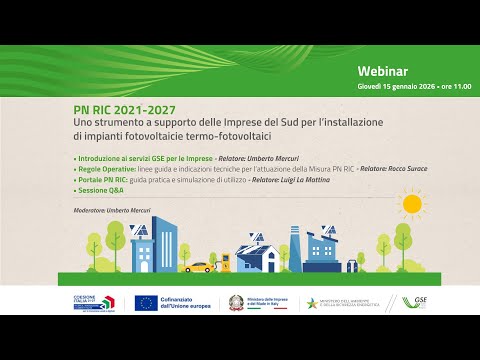
PN RIC 2021-2027 - PRODUZIONE DI ENERGIA DA FONTI RINNOVABILI: OPPORTUNITÀ IMPRESE DEL SUD ITALIA
Summary
The PN RIC 2021-2027 initiative allocates 262 million euros to support companies in Southern Italy for the installation of photovoltaic and thermal systems aimed at self-consumption. GSE provides services to assist companies in navigating the energy transition, enhancing competitiveness and sustainability.
GSE management mechanisms focus on five areas: energy efficiency, renewable sources, circular economy, innovation, and energy management. These mechanisms include white certificates for energy savings and long-term Power Purchase Agreements for renewable energy implementation.
The GSE facilitates photovoltaic installations in less developed regions of Italy, with specific criteria including a minimum capacity of 5,000 units. The PNRIC 2.2.1 initiative allocates a total budget of 262,000 euros, with 60% designated for small and medium-sized enterprises.
Companies of all sizes, including networks, can participate in the program if they meet specific eligibility criteria. These criteria include being regularly constituted, not under liquidation, and not affected by the Deocalization term in the preceding two years.
Perspectives
short
Support for Renewable Energy Initiatives
- Allocates significant funding to support renewable energy projects
- Encourages energy efficiency and sustainability among companies
- Facilitates access to financial incentives for small and medium enterprises
Concerns Over Implementation and Compliance
- Assumes companies will effectively utilize financial support
- Relies on companies to meet eligibility criteria and engage with the initiative
- Overlooks potential barriers such as lack of awareness or capacity among smaller firms
Neutral / Shared
- Establishes specific criteria for participation in the program
- Requires compliance documentation for energy consumption and project execution
Metrics
electric_consumption
360 teravats in 2030 teravats
projected electric consumption
This projection indicates a significant increase in energy demand.
the system that will be based on about 360 teravats in 2030
electric_consumption
320 teravats consumed in 2021 teravats
actual electric consumption in 2021
Understanding past consumption helps gauge future energy needs.
320 teravats, consumed in 2021
budget
262,000 euros EUR
total budget for the PNRIC 2.2.1 initiative
This funding is crucial for supporting energy transition efforts in less developed regions.
the compressive data of the mixture is of 262,000.
allocation_percentage
60%
percentage of budget allocated to small and medium-sized enterprises
This allocation aims to enhance the participation of smaller firms in renewable energy projects.
60% and, intended to the PMA, therefore, the small amount of companies.
capacity
10 kW and 1 megawatt kW
power generation requirements for new sections
This range defines the minimum and maximum capacity for new photovoltaic installations.
the device must have a power that will give 10kW and a megawatt
population
over 15,000 inhabitants people
minimum population for common units to transmit requests
This threshold ensures that product units are accessible and compliant with regulations.
the common population of over 5000 inhabitants
population
more than 15,000 inhabitants people
minimum population for common units to transmit requests
This threshold ensures that product units are accessible and compliant with regulations.
the common links that have more than 15,000 inhabitants
contract_duration
at least five years for large companies and three years for BMAs years
minimum contract duration for large companies
Long-term contracts may ensure stability but could hinder flexibility.
The contract has a duration of at least five years, for how much it takes to look at the large companies and three years for the BMA.
Key entities
Timeline highlights
00:00–05:00
The PN RIC 2021-2027 initiative allocates 262 million euros to support companies in Southern Italy for the installation of photovoltaic and thermal systems aimed at self-consumption. GSE provides services to assist companies in navigating the energy transition, enhancing competitiveness and sustainability.
- The webinar is part of a series dedicated to the PN RIC 2021-2027 initiative, which allocates 262 million euros to support companies in the South of Italy for the installation of photovoltaic and thermal systems aimed at self-consumption. Participants will receive a brief presentation on the services offered by GSE, followed by an overview of the operational rules for the PN RIC initiative by engineer Rocco Surace
- The GSE provides various services to assist companies in navigating the energy transition, which presents both challenges and opportunities for enhancing competitiveness and sustainability in the long term. GSE offers personalized assistance and a range of mechanisms and incentives to promote energy efficiency and the development of renewable sources, tailored to the specific needs of different industrial sectors
05:00–10:00
The GSE management mechanisms focus on five areas: energy efficiency, renewable sources, circular economy, innovation, and energy management. These mechanisms include white certificates for energy savings and long-term Power Purchase Agreements for renewable energy implementation.
- The GSE management mechanisms are categorized into five main areas: energy efficiency, renewable sources, circular economy, innovation, and energy management, providing tailored support for companies
- In energy efficiency, mechanisms include white certificates certifying energy savings and the updated thermal account 3.0 with new rules for applications
- Renewable sources are supported through mechanisms like XFR2 for implementing renewable energy and KCR for certifying renewable energy production
- Incentives for the circular economy focus on producing biomaterials and biofuels, while innovation is driven by digitization and transition mechanisms
- Power Purchase Agreements (PPAs) are long-term contracts essential for companies implementing renewable energy plants, influenced by market prices
10:00–15:00
The GSE facilitates photovoltaic installations in less developed regions of Italy, with specific criteria including a minimum capacity of 5,000 units. The PNRIC 2.2.1 initiative allocates a total budget of 262,000 euros, with 60% designated for small and medium-sized enterprises.
- The GSE provides a structured approach for companies to apply for incentives related to photovoltaic installations in less developed regions such as Calabria, Campania, Molise, Puglia, Sardinia, and Sicily. The installations must meet specific criteria, including a minimum capacity of 5,000 units
- The current initiative, PNRIC 2.2.1, is part of a broader economic plan managed by the Ministry of the Environment and Energy Security, with GSE playing a supportive role. The total budget for this initiative is 262,000, with 60% allocated to small and medium-sized enterprises, and 25% of that specifically reserved for small companies
15:00–20:00
Companies of all sizes, including networks, can participate in the program if they meet specific eligibility criteria. These criteria include being regularly constituted, not under liquidation, and not affected by the Deocalization term in the preceding two years.
- Companies of all sizes, including large, medium, and small enterprises, can participate in the program. Networks of companies are also eligible, enhancing overall participation
- To qualify, companies must be regularly constituted, registered with the appropriate trade chamber, and comply with all obligations, including social security contributions
- Eligibility criteria include not being under liquidation or listed on the internal Agenda Off list. Companies must also not have been affected by the Deocalization term in the two years preceding the application
- The Deocalization term specifies that companies operating internationally in the last two years cannot participate. However, national expansions within the internal market are acceptable
- Certain sectors, such as agriculture and ceramics, have specific limitations regarding participation. For example, agricultural production must meet quality standards, and mass production limits apply
- To access the program from January 1, 2026, companies must secure a stability contract. This requirement does not apply to companies that meet the criteria before December 31, 2025
20:00–25:00
The photovoltaic technology encompasses various components, including acquisition, transport, installation, and maintenance, with specific requirements for modules to qualify for incentives. New power sections must generate between 10 kW and 1 megawatt and be distinct from existing sections.
- The photovoltaic technology involves a combination of technologies, focusing on the acquisition, transport, installation, and maintenance of components, as well as project planning
- The primary circuit of thermal systems is encouraged, while the secondary circuit, including components like valves and pumps, is not incentivized under current guidelines
- Requirements for modules entering the PNR include adherence to established technical norms for photovoltaic cells to qualify for incentives
- New power sections must generate between 10 kW and 1 megawatt and must be separate from any existing power sections
- The accumulation system is encouraged within the photovoltaic framework and must be integrated into the new power section to meet outlined requirements
25:00–30:00
A product unit can be defined based on the share, allowing for multiple requests from different properties. The geographical distribution of product units is flexible, ensuring compliance with regulations.
- A product unit can be defined based on the share, allowing for multiple requests from different properties. However, if submitted from the same property, it will be blocked by the system
- Each product unit must be associated with a single request for emission, meaning the plant must be clearly defined and not spread across multiple locations. If a product unit has existing buildings, it can distribute the plant across several sections as long as everything connects to a single box
- The geographical distribution of product units is flexible, allowing for locations in northern regions or in Rome, as long as necessary criteria are met
- Common units with populations over 15,000 inhabitants can transmit requests, ensuring that product units are accessible and compliant with regulations