Energy / Europe
Monitor Europe energy trends, electricity markets, supply pressure, regulation and regional resource dynamics.
57. Energy-Charts Talks 02.03.2026: EEG-Novelle und Netzanschlusspaket
Summary
The EEG-Novelle 2027 introduces significant changes to the photovoltaic sector, including the removal of feed-in tariffs for systems up to 25 kWp. It aims to enhance direct marketing and streamline regulations, which may impact smaller producers who rely on guaranteed returns.
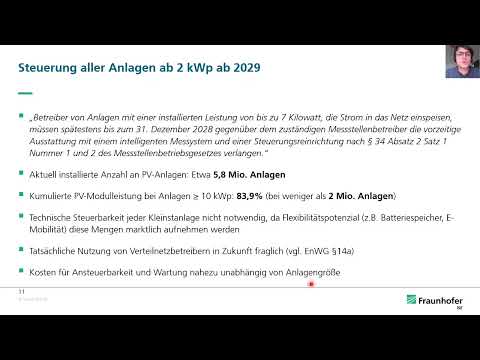
A market premium model is established, offering 6.2 cents per kilowatt-hour for larger installations, while all existing applications must be controlled by 2029 using intelligent metering systems. This shift raises concerns about the economic viability for smaller operators.
The lack of concrete construction targets for battery sources limits flexibility in energy supply and hinders the potential for last-mile flexibility in energy distribution. Self-consumption in photovoltaic systems can lead to significant savings, with examples indicating a 50% increase in efficiency.
The energy market is undergoing notable changes, with photovoltaic energy contributing nearly 3 percent to the overall supply. Wind power has seen a decline from 5.5 percent to 3.1 percent since 2015, highlighting the need for reevaluation of market strategies.
Perspectives
short
Supporters of EEG-Novelle 2027
- Introduce market premium model for larger installations
- Enhance direct marketing for photovoltaic systems
- Streamline regulations to improve efficiency in energy sector
- Encourage self-consumption to increase savings for users
Critics of EEG-Novelle 2027
- Lack of construction targets for battery sources limits flexibility
Neutral / Shared
- Photovoltaic energy contributes nearly 3 percent to overall supply
- Wind power has declined from 5.5 percent to 3.1 percent since 2015
Metrics
applications
6 million applications units
total number of applications in the company
This indicates the scale of the existing photovoltaic market.
we have currently 6 million applications in the company
performance
84 percent %
accumulated PV performance of applications greater than 10 kilowatt-hour peak
This shows the majority of applications are performing at a high capacity.
the accumulated PV performance of the applications is greater than 10 kilowatt-hour peak, is 84 percent
applications
2 million applications units
number of applications greater than 10 kilowatt-hour peak
This highlights the significant number of high-capacity installations.
with a little less than 2 million applications
applications
16 percent %
remaining applications that need to be controlled
This indicates the portion of applications that may require additional oversight.
to control the remaining 16 percent
efficiency
50%
increase in efficiency from self-consumption in photovoltaic systems
Higher efficiency can significantly reduce energy costs for industries.
50% more with 30 terabytes per hour, compared to 20 terabytes per hour.
energy_production
2.6 terawatt hours
recent photovoltaic energy production
This highlights the growing importance of solar energy in the overall energy supply.
we now have a free-dispatch under the energy. That is a two-name in the last year to be announced on 2.6 terawatt hours
energy_contribution
nearly 3 percent %
photovoltaic energy's contribution to overall energy supply
It underscores the increasing role of solar energy in the energy mix.
it is almost 3 percent
wind_power_percentage
5.5 percent to 3.1 percent %
decline in wind power contribution since 2015
This trend indicates a need for reevaluation of market strategies to enhance wind energy's contribution.
the relatively number has also taken strong from 5.5 percent to 3.1 percent
Key entities
Timeline highlights
00:00–05:00
The EEG-Novelle 2027 introduces changes to photovoltaic systems, including the removal of feed-in tariffs for systems up to 25 kilowatt peak. It aims to enhance direct marketing and streamline regulations in the energy sector.
- The EEG-Novelle 2027 introduces significant changes, including the removal of feed-in tariffs for photovoltaic systems up to 25 kilowatt peak and a refinance contribution for larger systems. This aims to enhance direct marketing and distribution for installations exceeding 25 kilowatt peak
- Key focuses include the implementation of the Net-Zero Industry Act (NZIA), adjustments to the Strom Mengenpfad (§4a), and changes to distribution volumes and maximum values. These modifications are intended to streamline regulations and improve efficiency in the energy sector
- A 50% rule for storage systems up to 100 kilowatt peak will impact their integration into the energy market, while regulations for balcony solar systems will largely remain unchanged. This ensures continued support for small-scale solar installations
- Construction goals include an annual target of 14 kilowatt peak for free-field installations and 10 kilowatt peak for larger buildings. This structured approach aims to facilitate the growth of storage solutions in line with energy demands
- At least 64% of construction is expected to occur on free-field installations if the 6.5 kilowatt peak threshold is met. This indicates a strong push towards optimizing land use for solar energy generation
- Challenges persist in achieving economic acceptance and power selection within the energy charts. Ongoing adjustments are necessary to meet construction requirements and environmental considerations
05:00–10:00
The EEG-Novelle 2027 eliminates feed-in tariffs for photovoltaic systems up to 25 kWp and introduces a refinance contribution for larger systems. It aims to enhance direct marketing and streamline regulations in the energy sector.
- The EEG-Novelle 2027 removes feed-in tariffs for photovoltaic systems up to 25 kWp and introduces a refinance contribution for larger systems. This aims to enhance direct marketing and distribution for installations exceeding 25 kWp, while a new manufacturing model for small installations seeks to increase their market value
- The implementation of intelligent metering systems is essential for the new market management model. These systems must be installed before applications can be processed, ensuring effective monitoring of energy production
- Current market values for solar energy, recorded at 4.51 kWh last year, are crucial for assessing the economic viability of solar installations. This data informs decisions regarding future investments and the transition to direct market applications for larger installations
10:00–15:00
The EEG-Novelle 2027 removes feed-in tariffs for photovoltaic systems up to 25 kWp and introduces a market premium model offering 6.2 cents per kilowatt-hour. This model aims to enhance direct marketing for larger installations while ensuring that all existing applications must be controlled by 2029 using intelligent metering systems.
- The EEG-Novelle 2027 removes feed-in tariffs for photovoltaic systems up to 25 kWp and introduces a market premium model for installations with a capacity of 25 kWp, offering a fixed value of 6.2 cents per kilowatt-hour. This model aims to enhance direct marketing for larger installations while ensuring that all existing applications must be controlled by 2029 using intelligent metering systems
15:00–20:00
The EEG-Novelle 2027 introduces a market premium model for photovoltaic systems, replacing feed-in tariffs for systems up to 25 kWp. This change aims to enhance direct marketing and streamline regulations in the energy sector.
- The relationship between module applications and exchange rate applications reflects a significant technical understanding of PV module performance. It is essential that the performance of a PV module does not exceed the performance in Gigawatt Peak, which is a standard test requirement
- The mark premium model operates differently from fixed contracts, relying on defined values to determine the difference between dependent values and the monthly market value. The over-earned payment required in Europe is contingent on the size of the contract and the market value of energy tracking
- The construction of renewable energy sources is robust, but economic income is challenged by the rules governing electricity pricing. If the electricity price surpasses the refinance price, it will lead to a reduction in the electricity generated from private kilowatts
20:00–25:00
The lack of concrete construction targets for battery sources limits flexibility in energy supply and hinders last-mile flexibility in energy distribution. Self-consumption in photovoltaic systems can lead to significant savings, with examples showing a 50% increase in efficiency.
- The lack of concrete construction targets for battery sources limits flexibility in energy supply and hinders last-mile flexibility in energy distribution
- Since 2015, the supply of photovoltaic applications has been low, affecting overall flexibility in the energy sector due to unmet discount costs associated with new applications
- Self-consumption in photovoltaic systems, particularly in industries exempt from network fees, can lead to significant savings, with examples showing a 50% increase in efficiency
- The network connection package emphasizes the need for better prioritization in net access support, addressing capacity and improving market communication
- Data laws present challenges in achieving transparency regarding network access, limiting the ability to gather information on regional performance potential
- Understanding the current performance of installed wind and solar energy systems is crucial for effective planning and performance development over the next decade
25:00–30:00
The energy market is experiencing significant changes, particularly with photovoltaic energy contributing nearly 3 percent to the overall supply. Wind power has declined from 5.5 percent to 3.1 percent since 2015, indicating a need for reevaluation of market strategies.
- The current market-based regulation for energy shows a potential market value influenced by net income and budget conditions. Negative budgets can lead to the removal of certain numbers from consideration, reflecting a significant change in market dynamics since 2015
- Photovoltaic energy has seen a notable increase, with a reported 2.6 terawatt hours achieved recently. This represents a nearly 3 percent contribution to the overall energy supply, highlighting the growing importance of solar energy
- The distribution of energy production between market-based regulation and free-dispatch is heavily dependent on electricity market design. An increase in electricity production necessitates greater distribution, which reduces reliance on free-dispatch
- Wind power has experienced a decline in relative numbers, dropping from 5.5 percent to 3.1 percent since 2015. This trend underscores the need for a reevaluation of market strategies to enhance wind energys contribution